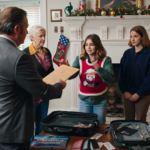
THE SCHOOL CALLED. “YOUR DAUGHTER HASN’T BEEN PICKED UP. IT’S BEEN 3 HOURS.” I SAID…..
Architect Lena Hail receives a shocking call from a school about a daughter she never knew she had. Arriving, she finds a little girl, Lily, who is her exact physical copy.
Lena soon uncovers a devastating betrayal: her ex-boyfriend, Daniel, stole her frozen eggs, forged her signature, and used a surrogate to create Lily. He then abandoned the child for Lena to find.
Instead of seeking revenge, Lena uses her architectural focus and the cold, hard evidence of the fraud. She legally and systematically erases Daniel from their lives, winning full custody and finally building a true family.
The school called. Your daughter hasn’t been picked up. It’s been 3 hours. I said, “My name is Lena Hail. I’m 28. I’m an architect in Portland. I thought I was ordinary.” Then one phone call rewrote my entire life.
The call came on a Tuesday. 6:42 p.m. I was at my desk, my fingers black with charcoal from a sketch. I was designing a library, a quiet, safe building. My phone buzzed. An unknown number.
“This is Lena Hail.”
A woman’s voice, tight with frustration. “Miss Hail, this is Cresview Elementary. Your daughter hasn’t been picked up. It’s been 3 hours.”
I stopped breathing. The charcoal pencil rolled off my desk and snapped on the floor.
I said, “You have the wrong number. I don’t have a daughter.”
Silence. Then the woman sighed, a sound so tired it hurt.
“Is this Lena Hail? 4500 Westland Drive?”
“Yes, but—”
“Then she’s your daughter. She’s right here. She’s the last one, Ms. Hail. We’ve been calling for hours.”
My first thought: a prank. My second: why did she sound so sure?
“I’m telling you, I don’t have a child,” I said again. My voice was shaking.
“She’s asking for you. By name.”
I hung up. I stared at the wall. My heart was a hammer. I didn’t have a daughter. I knew my own life.
But I grabbed my keys. I don’t know why. I just—I had to see. I had to see the face of the lie.
But before I tell you how everything flipped, like and subscribe. Drop a comment. Where are you watching from?
The drive to the school was only 15 minutes. It felt like an hour. My knuckles were white on the steering wheel. The rain was heavy and the windshield wipers made a terrible screaming sound. Screech. Thump. Screech. Thump.
“This is a mistake,” I kept saying. “A stupid clerical error. Someone with the same name. It happens.”
But the woman’s voice. She’s asking for you by name.
How—how could a child I’ve never met ask for me?
Maybe it was a trap, a scam. Someone wanted to get me to a dark school. But that made no sense. This was an elementary school, not a dark alley.
I pulled into the parking lot. It was empty except for one red sedan parked near the entrance. The building was dark, just like the woman said. Only one light was on. The main office.
I sat in my car for a full minute. My heart was high in my throat. I felt cold.
Go in. Prove them wrong. Go home.
I got out of the car. The rain hit my face. I didn’t have an umbrella. I ran to the glass doors and pulled. They were locked.
I knocked.
A moment later, the woman from the phone appeared. She looked at me, then unlocked the door.
“Thank God,” she said. She was in her 50s, with tired hair and a gray cardigan.
“I’m Mrs. Davies.”
“I’m Lena Hail,” I said, water dripping from my hair onto the floor. “I think there’s a serious mistake. I am not a mother. I don’t have a child.”
Mrs. Davies did not look surprised. She just looked sad. She crossed her arms.
“You’re telling me you’ve never seen her before?”
“Seen who? I don’t know who you’re talking about.”
“She’s been here all day,” Mrs. Davies said. She sounded angry now. Angry at me, as if I was a terrible parent who was lying. “She had a normal day. She went to class, and at 3:30 no one came. We called the number on the emergency form. We called your number.”
I felt like I was in a nightmare.
“What form? I never filled out a form.”
“She’s just down the hall,” Mrs. Davies said. She pointed. “See for yourself.”
I looked past her. The school was dark. The lockers were a dull gray-green. The smell: it was floor wax, wet rain, and that faint sweet smell of cafeteria food.
And at the end of the hall, on a long wooden bench, sat a little girl.
She was tiny. She was sitting perfectly still, her knees tucked up to her chest. Her feet in little pink sneakers didn’t touch the floor. She had on jeans and a purple jacket. Beside her on the bench was a backpack. It was shaped like a white rabbit.
I didn’t move. Mrs. Davies stood behind me, watching me, waiting.
“Go on,” she said.
I took a step. My shoes squeaked on the tile. Squeak, squeak. The sound made the little girl look up. Her head lifted. She turned—and all the air left my body.
I stopped. I couldn’t move. I couldn’t breathe.
It was my face.
It was my face looking back at me. It was my blonde hair. It was my—it was my green eyes, the same shade, the kind people always called too bright.
And then I saw it, just above her lip on the left side. A tiny white scar. A vertical line.
I got that scar when I was six. I was on the swing set at my grandmother’s house. I tried to jump off. I fell. I hit my face on the metal pole. I have seen that scar in the mirror every single day of my life.
And this little girl had it.
My hand went up to my own mouth. I touched my scar.
The little girl just watched me. She wasn’t scared. She looked relieved. She stood up from the bench. She took one step toward me and she whispered it.
“Mommy.”
It was not a question. It was a statement.
“No,” I whispered. I took a step back. I bumped into Mrs. Davies. “No,” I said louder. “I don’t know you. This isn’t—this isn’t possible.”
The little girl’s face crumbled. She didn’t cry. She just looked lost. Her eyes filled with tears, but they didn’t fall. She looked at me like I was the one who was crazy.
“But Daddy said you would come.”
A man came out of the office. He was wearing a tie.
“Mr. Henderson,” Mrs. Davies said.
The principal.
“Ms. Hail,” he said. His voice was gentle. “I’m glad you’re here. We were very worried about Lily.”
“Lily,” I repeated. The name meant nothing. “I am not her mother,” I said. My voice was shaking. I was starting to panic. The walls felt too close. “I have never seen this child before. This is a mistake or a crime. I don’t know what it is, but she is not mine.”
Mr. Henderson frowned. He looked at Mrs. Davies. He looked back at me.
“Ms. Hail, I understand you’re upset, but she was enrolled here last August by a man who listed you as the primary guardian.”
“A man who?”
“He’s listed as the father,” Mr. Henderson said. He went into the office. I followed him. The little girl stayed by the bench.
He opened a file.
“This is the enrollment packet.”
He turned it around and I saw it. All the forms: emergency contacts, medical history, authorization to pick up. And at the top, in the mother/guardian box, was my name, Lena Hail. My address, my new address in Portland. My cell phone number. And my signature.
It was my signature.
I am an architect. My signature is specific. The fast sharp L, the high crossed H in Hail. It was perfect. It was my handwriting.
But I had never ever written it.
I stared at the paper. I felt the blood drain from my face. I put my hand on the desk to stay standing.
“Who—who brought this in?” I whispered.
“I don’t know,” Mr. Henderson said. “It was in her file when she transferred here. We assumed it was you.”
“This is a forgery,” I said.
“Ms. Hail,” he said, his voice firm but kind, “that’s a very serious accusation. The fact is this child is here. She says you are her mother. Your name is on this form. We’ve been calling you. You are her guardian. I cannot let her go home with anyone else. And I cannot keep her here.”
He was right. He was trapped. And he had just trapped me.
I looked back down the hall. The little girl—Lily—she was watching me, waiting, as if she knew I was her only ride.
What could I do? Call the police?
“911, what’s your emergency?”
“There is a child who looks just like me and she has my scar and my name is on a form I didn’t sign.”
I would sound insane.
I couldn’t leave her here. They would call child services and—and what if she was—
No. I had to solve this. And I couldn’t solve it in a school lobby.
I took a deep breath.
“Okay,” I said. My voice was dead. “I’ll take her.”
Mrs. Davies let out a long breath. “Thank you. Just—just sign her out for us.”
She handed me a clipboard. I picked up the pen and I signed my name, my real signature, right next to the fake one. They looked exactly the same.
I walked back to the girl. She looked up at me.
“Hi,” I said. My voice was a croak.
“Hi, Mommy.”
“My name is Lena,” I said. “You can call me Lena.”
She looked confused.
“Okay.”
I reached out my hand. “Let’s go.”
She put her small, warm hand in mine. It fit perfectly.
I walked out of that school holding the hand of a stranger who had my face.
We got in the car. I put her in the back seat. I didn’t have a car seat. I didn’t even think about it. I just drove.
The drive home was silent. Just the screech-thump of the wipers.
In the rearview mirror, I watched her. She was just looking out the window.
“Are you hungry?” I asked. The silence was too much.
“Yes,” she whispered.
“What do you like to eat?”
“Macaroni.”
I stopped at the grocery store. I ran in. I bought a blue box of macaroni and cheese. I bought milk. I bought apple juice and a box of cookies.
The cashier smiled at us.
“She’s beautiful,” the cashier said. “Looks just like you. A mini-me.”
I just nodded. I couldn’t speak. I paid. I left.
I drove to my clean, quiet adult apartment. The one with glass tables and white walls. The one with my blueprints and charcoal sketches. My life.
I walked into my apartment and I held the door open for a child who called me Mommy.
My life was over.
I was the victim of a crime. A crime I couldn’t even name.
My apartment felt wrong. It was too quiet. The gray minimalist furniture looked cold and sharp. This was not a place for a child.
Lily stood in the entryway, dripping water on my hardwood floor. She held her rabbit backpack in front of her. She looked like a little soldier.
“You can put your bag down,” I said. I sounded like a stranger.
She put it by the door.
“Are you—are you really hungry?”
She nodded.
“Okay. Macaroni. I can do that.”
I went into my kitchen, my beautiful steel kitchen. I almost never cooked. I opened my cabinets. I had pasta. I had wine. I had coffee.
I had to find the pot I bought 3 years ago and never used.
I found the blue box. I read the instructions. Boil water. Add pasta. It felt stupid. My world was ending and I was boiling water.
I could feel her watching me. I turned. She was sitting at my dining room table. Her hands were in her lap.
“What’s your name?” I asked again. I needed to hear her say it.
“Lily.”
“Lily. That’s a pretty name. Lily? What’s your last name?”
She looked at her shoes.
“Carver,” she said.
The wooden spoon I was holding clattered into the sink.
Carver.
No. It couldn’t be. It was a common name. It had to be a different Carver. But the scar, the eyes, the forged signature.
“Lily,” I said, and my voice was sharp. She flinched. I tried again, softer. “Who usually picks you up from school?”
“Daddy.”
“What—what is your daddy’s name?”
She looked up at me, her green eyes, my green eyes.
“Daniel,” she said.
The name hit me. It was not a sound. It was a physical blow. The room spun. I had to grab the back of the dining room chair.
Daniel. Daniel Carver.
Not a ghost, a bomb. My past had just exploded in my kitchen.
Daniel Carver was not just someone I dated. He was the man I was going to marry. I met him 6 years ago. We were both young architects in Seattle. We worked at the same firm. We fell in love over blueprints and cheap wine.
He was brilliant. He was funny. He was everything. He knew me. He knew every story. He was the one I told about the swing set. He had traced the scar on my lip with his finger and said, “This is my favorite part.”
He knew my handwriting. We used to practice signing each other’s names, laughing about it. “I could be you,” he’d said.
He was my life.
And then 5 years ago, he vanished.
It was a Tuesday, just like today. I came home from a work trip. The apartment was empty. His clothes were gone. His books were gone. His drafting tools were gone. There was a note on the counter.
“I’m sorry. This is for the best.”
I didn’t understand. I called his phone. Disconnected. I went to the office the next morning. Our boss looked at me with pity.
“Lena, he quit a week ago.”
“He said he was moving.”
“Moving where?”
“He didn’t say. He just left.”
He evaporated. He took 5 years of my life and turned them into smoke.
I grieved. I was broken. I cried for months. Then I got angry. I rebuilt my life. I moved to Portland. I started my own firm. I buried Daniel Carver so deep in my past, he was nothing but a bad memory.
Now he was back. And he had sent a child.
I looked at Lily. She was watching me, scared.
“How—how old are you, Lily?” I asked.
“I’m four.”
Four.
He left 5 years ago. The math was simple. And it was impossible.
He left me in August. A baby born 9 months later. He—he left me and he was with someone else. Someone who looked like me.
No, that didn’t make sense. The scar.
He—he left me and I was—
No,” I said out loud. “I wasn’t pregnant. I know I wasn’t. I would know. A person knows if they had a baby.”
The macaroni was boiling over. Water was hissing on the stove. I grabbed the pot, burning my hand. I dropped it. Pasta scattered everywhere.
I just stared at the mess.
Lily started to cry.
The sound snapped me back.
“It’s okay,” I said, my voice shaking. “It’s okay. I’m sorry. I’m just—I’m just surprised.”
I cleaned up the mess. I made her a peanut butter sandwich. She ate it. I sat across from her. My mind was racing.
Daniel. He had forged my name. He had enrolled this child in a school. He listed me as the guardian. And then he disappeared again. He had left her just like he left me. He had found a way to write me back into his story.
“Lily,” I said gently. “What did—what did Daniel tell you about me?”
She finished her bite.
“He said you were my mommy.”
“But where was I?”
“He said you were very, very busy at your work. He said you were sick for a long time, but that you loved me. He had pictures of you.”
“Pictures?”
My blood went cold.
“In a box. He said you were a secret. He said I couldn’t meet you. Not yet. But he said if he ever had to go away on a long trip, you would come for me.”
The lies. The calculated, careful lies. He had built a mythology around me. He didn’t just steal my name. He stole my story. He made me the absent mother. The tragic, busy, sick woman who couldn’t be there. He made me the villain in her life. And he made himself the hero who stayed.
Until today.
“He’s wrong,” I said. My voice was hard.
“Wrong about what?”
“About me. I wasn’t sick. I wasn’t busy.”
I took a breath.
“I just—I didn’t know you were here.”
She just stared at me.
That night, I made her a bed on my sofa. I used my best sheets. I covered her with my favorite blanket. She was asleep in 5 minutes.
I went to my computer. My hands were shaking, but not from fear. It was rage. My old life was over. My new one had just begun. I was going to find out what he did. I was going to find out how he did it. And then I was going to find him.
Lily was asleep. The apartment was completely dark except for the blue glow of my laptop screen. My office light was on. I was at my desk. This was my space, my comfort zone. I’m an architect. I solve problems. I analyze structures. I find the flaws. I find the truth.
This was a structure. A structure of lies. Daniel built it. I was going to tear it down.
I started with my own life. I had to prove I was sane. I had to prove I was right.
I opened my work calendar. I went back 5 years. The year he left, August 2020. I had the Seattle Tower project. I was working 80-hour weeks. I was not pregnant.
I went forward. September, October, November. All work, meetings, deadlines. Then I looked at the next spring, April 2021, 9 months after he left, the month Lily would have been born.
My calendar was full.
April 10:15: Chicago pitch Ktow Tower project.
I remembered that trip. It was my first big project after moving to Portland. We won the bid. I was in Chicago. I had the plane tickets in my email. I had the hotel receipts. I had photos from the dinner. I was not in a hospital. I was not having a baby.
This was my alibi, my anchor to reality.
So how—
I opened my bank statements, my credit card statements. I went back 5 years. I looked for—I didn’t know what. Diapers, a doctor I didn’t remember. Nothing.
My finances were clean. My travel was all for work. There was no room in my life for a baby.
He must have used a different woman. A woman who looked like me. A woman he—
But the scar. You can’t fake a scar like that.
I kept digging.
I went to my old credit card. The one I opened in Seattle. The one I barely used. I scrolled through the statements. 2021, January, February, March, nothing.
April. April 12th, 2021. A charge: St. Mary’s Hospital. C-ay $50.
I froze.
St. Mary’s. I never go to St. Mary’s. It’s across town. I use Good Samaritan. But the date, April 12th. I was in Chicago. How could I be in two places at once?
It was 2:00 a.m. I called the hospital. My heart was pounding.
“St. Mary’s Hospital. How can I help you?”
“Records,” I said. “I need to speak to medical records.”
A sleepy clerk answered.
“Medical records.”
“Hi,” I said. I tried to sound calm. “I need to get my records from April 2021. It’s—it’s an emergency. I think—I think my identity was stolen.”
The word stolen woke her up.
“Ma’am, you need to come in and fill out a formal request. We can’t give that over the phone.”
“I can’t,” I said. My voice was rising. “I have—I have a child here. She’s—she’s sleeping. I need the records. Now. Please. I can give you my social security number, my date of birth.”
I sounded desperate. I was desperate.
The clerk sighed.
“Ma’am, please—”
“I was a patient. I just—I was very sick. I don’t remember it clearly. I need to see the file.”
A lie. It was a lie. But I had to know.
She put me on hold. The music was terrible. I waited. I stared at the sofa, at the small lump under the blanket. Lily.
The clerk came back. “Okay. This is against policy, but I can email you a summary. A discharge summary. That’s all I can do. You’ll need to come in for the full file tomorrow.”
“Yes. Thank you. Thank you.”
I gave her my email address. I refreshed my inbox. Refresh. Refresh. Refresh.
Ding.
The email was there.
Subject: discharge summary. Patient 406.
I clicked it. A PDF attachment. I opened it.
Patient: Lena Hail.
Date of admission, April 12th, 2021. Date of discharge, April 14th, 2021.
Service, maternity wing. Room 406.
Physician, Dr. J. Ays.
Patient status: discharged stable.
Child: female. Weight 7 lb 2 oz.
Mother: Lena Hail.
Father: unknown.
I read it five times.
It was real.
Someone—someone pretended to be me. Someone checked into a hospital as Lena Hail. Someone had a baby. While I was in Chicago.
I scrolled to the bottom. Scanned notes. A nurse’s handwriting.
Patient is anxious, restless, refuses to list father. Patient states she is in danger. Fears for child.
And one more line. A handwritten note that chilled me to my soul.
Mother insisted child’s father must never know. Said he’d ruin everything.
It was a lie. A brilliant, terrible lie. It was a script.
Daniel hadn’t just faked my name. He had faked my story. He had some woman, some actress, go to a hospital, give my name, have this baby, and then he created this narrative, this lie that I was the one who was unstable, that I was the one hiding the baby from him.
He had been planning this for years. He was building his defense so that if I ever did find out, I would look like the guilty one. I would look like the mother who abandoned her child.
He had covered every track. He had made me the villain.
But the child. If I wasn’t the mother, if I was in Chicago, then who was in room 406?
And why? Why does Lily have my face? Why does she have my scar?
The thought was so dark, so impossible. I had to know.
The hospital record was a lie. But was the child?
I looked at Lily sleeping on my sofa. I had to know the truth. I had to know if she was mine.
The next morning, I called my boss.
“I have a family emergency,” I said. The word family felt like acid in my mouth. “I need to work from home. I don’t know for how long.”
He was kind. He said to take all the time I needed.
I hung up. A new day.
Lily was awake. She was sitting at my table eating cereal I’d bought. She was watching cartoons on my laptop. She looked normal. She looked like a little girl.
I was standing by the counter holding my coffee. I was staring at her. The scar, the eyes. The hospital record was a lie. I was in Chicago.
But was the baby a lie? How? How could she be mine?
I told myself I wouldn’t do it. It was too crazy. It was a violation. But I did. I had to.
“Hey, Lily,” I said. My voice was too bright. “We’re going on an adventure.”
She looked up, her eyes wide.
“An adventure where?”
“To the store. A special store.”
I took her to the pharmacy. She held my hand. Her hand was so small.
I walked down the aisle. Vitamins, band-aids, home testing. There it was.
DNA test kit. Peace of mind. Paternity. Maternity. 99% accurate.
I grabbed a box. I also grabbed crayons and a coloring book.
The cashier smiled at us.
“Getting a coloring book for your daughter?”
“Yes,” I said.
The word came out. It sounded real.
I felt like a monster. I felt like a criminal. I was deceiving this child. I was becoming like him.
No. I was fixing what he did. I was finding the truth.
We went home. I gave her the coloring book. She sat on the floor, happy.
I went into the kitchen. I opened the box. My hands were shaking. Instructions, cheek swabs, envelopes, legal form. I needed her DNA.
I went to her rabbit backpack. I pulled out a small pink hairbrush. It was full of blonde hair. My hair.
I pulled out a few strands. The instructions said a cheek swab was better. My stomach turned.
“Hey, Lily, can we play a silly science game?”
She looked up.
“What game?”
“The who are you game.” I knelt on the floor. I opened one of the swab packets. “I just have to rub this on your cheek. It’s silly. It tickles.”
She giggled.
“Okay.”
I swabbed her cheek. My hand was trembling.
“My turn,” I said.
I went into the bathroom. I locked the door. I looked in the mirror. My eyes. Her eyes. My scar. Her scar.
I swabbed my own cheek. I sealed the envelopes. I put them in the prepaid mailer.
I put on my shoes.
“I’ll be right back,” I said. “Keep coloring.”
I walked to the blue mailbox on the corner. I held the envelope over the slot. This was it. This was the moment. If I drop this in, there is no going back.
If it’s a match, what does that mean? How is it possible?
If it’s not a match, then who is she? And why does she look like me?
I let it go. It thudded to the bottom of the box. The sound was so final.
I went back.
The website said 2 weeks.
2 weeks.
It was the longest 2 weeks of my life. It was 2 weeks of pretending. 2 weeks of checking my phone every 5 minutes.
I had to work. I had to be a—a person. And I had to take care of Lily.
I bought her a bed. I moved my drafting table out of my spare room. We painted one wall pink. My gray sterile apartment was invaded by toys, by small shoes, by the sound of cartoons.
We fell into a routine. Breakfast, cartoons. I worked. She drew. She drew pictures of me, of her. Of a yellow house. She never drew Daniel.
She was—she was a person. She wasn’t just a mystery. She was smart. She was stubborn. She was funny. She refused to eat tomatoes. She loved music. She started to laugh. She wasn’t the terrified, quiet girl from the school. She was—she was happy.
And I—I was terrified.
I was terrified of the answer. I was terrified she wasn’t mine. And I was more terrified that she was. Because if she was mine, how?
My mind kept going back. Daniel. The hospital.
And then I remembered a conversation 6 years ago in Seattle.
We were in our old apartment. We were drinking wine.
“I’m worried,” I said.
“About what?” he asked.
“My career. I want to build. I want to be a partner, but I want a family, too. I’m scared I’ll wait too long.”
He took my hand.
“We have time.”
“I know, but I was thinking maybe I should freeze my eggs. Just as an insurance policy.”
I remembered his smile.
“That’s my practical Lena, always building. Even a backup plan.”
I went to a clinic, a consultation. I filled out forms. So many forms. I signed my name. Over and over. Daniel was with me. He held my hand. He said, “Whatever you decide, Lena, I’m with you.”
I never went back. I got busy. The Ktower project came up. I never had the procedure.
Did I?
Oh, God.
He knew the clinic. He knew the doctor. He knew I signed the consent forms.
“I could be you,” he’d said.
He didn’t just forge my name at a school. He didn’t just hire an actress. He—he stole—he stole my eggs. He found a surrogate. He used my genetic material. He manufactured my child without my knowledge. Without my consent.
This wasn’t a custody battle. This was a theft of the most profound kind. He didn’t just steal my past. He stole my future. He stole my body.
The email came on a Tuesday morning.
Subject: Your results are ready.
I was in my car in the parking lot of the grocery store. I couldn’t open it in the apartment. Not with her there.
My hands were so cold. I logged in. I clicked the link.
Maternity test results.
Lena Hail. Lily Hail.
I scrolled past the science. I just looked for the number.
There it was.
Probability of maternity 99.8%.
I didn’t cry. I just sat in my car. The silence was deafening. The kind of silence that comes right before you stop being who you were.
She was mine.
She was mine.
He took her from me before I even knew she existed.
The confusion was gone. The fear was gone. All that was left was rage. It was so cold. It felt like ice in my veins.
I was not confused anymore. I was not a victim. I was a mother. And I was going to get my daughter.
I was not confused anymore. I was not a victim. I was a mother. And I was going to get my daughter.
The DNA results didn’t make me cry. They made me cold. The number on the screen, 99.98%, was not a confirmation of family. It was a receipt for a crime. It was proof of the theft. She was mine. He stole her.
He stole her from my body, from my future, from a clinic where I had gone for a consultation. He had used my signature, my genetic material, and my trust. He had hired a stranger to carry my child and then forged hospital records to frame me as an unstable, runaway mother.
He hadn’t just left me 5 years ago. He had plundered me.
The confusion was gone. The shock was gone. All that was left was a silence in my mind, a cold, clear space.
I was not a victim anymore. I was a mother, and I was going to get my daughter.
The next morning, I moved my life around. I called my boss and told him the family emergency was now a legal one, and I needed indefinite leave. I moved half my savings into a new checking account.
Then I hired a private investigator.
He was a man named Caris. He had a small, dusty office downtown. He was ex-police. He looked at me over his glasses.
“What can I do for you, Ms. Hail?”
I didn’t tell him the whole story. I didn’t need to.
“I need to find a man,” I said. I slid a piece of paper across his desk. It had Daniel’s full name, his old Seattle address, and the address of Crestview Elementary. “His name is Daniel Carver. He just abandoned his 4-year-old daughter at this school. He listed me as the guardian. I need to know where he is now.”
Caris looked at the paper.
“Abandoned?”
“He told her he was going on a long trip. The school called me. I have her.”
“And your relationship to Mr. Carver?”
“We used to work together,” I said. “A long time ago.”
“And the child?”
I met his eyes.
“The DNA test says she’s mine.”
Caris didn’t flinch. He just nodded, as if this was normal. Maybe it was.
“This is a custody matter then. You’re trying to serve him.”
“I’m trying to find him,” I said. “I will handle the rest.”
“I’ll have an address for you in 48 hours,” he said.
He had it in 24.
The call came while I was on the floor building a block tower with Lily. She was laughing. It was a bright, beautiful sound. My phone buzzed.
“M. Hail. Caris.”
I stood up.
“Go ahead.”
“He’s not at the address on the school forms,” Caris said. “He moved out 2 days ago. The same day you picked up the girl.”
Of course he did. He was running. He had left her like a package on a doorstep.
“He’s in a rental in the suburbs. Lake Oswego. 14 Cherry Blossom Lane. White house, white fence. He’s paying in cash. He’s hiding.”
“Thank you,” I said. “Send me the bill.”
I hung up. I looked at Lily.
“Mommy has to go to a meeting. A work meeting.”
I hated lying to her. It was his poison and he was making me use it.
I called my colleague Sarah. She had a daughter of her own.
“Sarah, I need a favor. The biggest favor I will ever ask.”
An hour later, Lily was at Sarah’s house, happily playing.
“Is everything okay, Lena?” Sarah asked, her eyes full of worry.
“It will be,” I said.
The drive to Lake Oswego was long. It was the rich, quiet suburbs. Perfect lawns, big silent houses. It was everything he used to say he hated. He called it a suburban lie.
He had become his own cliché.
I found the street, Cherry Blossom Lane, and there it was. Fourteen. White house, white fence, a perfect manicured lawn. A perfect lie.
I parked. I walked up the path. My heart was not pounding. It was slow, heavy, a single steady drumbeat. Thud, thud, thud.
I was not angry. I was focused, like I am before a presentation. I had my facts. I had my case.
I rang the doorbell.
I waited.
I heard movement. The lock clicked. The door opened.
He stood there.
He looked smaller, thinner. His hair was messy. He wasn’t the brilliant, confident man I remembered. He was just a man.
He saw me, and he wasn’t surprised. He didn’t say, “Lena, what are you doing here?” He just nodded. He had been expecting me. This was the day he had been dreading for 5 years.
“Lena,” he said.
“Hello, Daniel.”
He had the nerve to try and smile. It was a terrible, wet, frightened thing.
“You found her,” he said. Not you found me. “You found her. Our little secret.”
“She’s not a secret, Daniel,” I said. My voice was low. I didn’t want the neighbors to hear. “She’s a person. And she’s not ours. She’s mine.”
“She’s my daughter, Lena,” he said, stepping back. He let me in. The house was empty, just boxes. He was ready to run again. “I’m the one who raised her. I’m the one who was there.”
“You’re the one who stole her,” I said. I walked into the empty living room. I didn’t sit.
“The clinic,” I said. “Seattle. 2019. How did you do it?”
He looked away. He ran his hands through his hair.
“You—you signed the forms. We both did the consultation. You said you wanted a backup plan.”
“I never went back,” I said. “I never had the procedure.”
“You didn’t have to,” he whispered. “The consent was signed. For retrieval, for fertilization, for surrogacy. You signed all of it. You were so busy with the K-Tower pitch, you just signed everything the doctor gave you.”
I felt sick. He was right. I had been in a hurry. I had trusted him.
“I—I told them we were proceeding,” he said. “I paid for it. I found a surrogate. I—I wanted her. Lena, I wanted a family.”
“You wanted my family,” I said. “You wanted my child without me.”
“Because you wouldn’t have done it,” he shouted. His voice cracked. “You would have chosen your job. You would have waited until it was too late. I did it for us.”
“You did it for you,” I said. “You lied to me and then you left me and you took my daughter.”
He stepped toward me. His eyes were wild, desperate.
“I had to. I had to take her and I had to keep her safe.”
“Safe?” I laughed. “Safe from what?”
And then he said it. The line he had been practicing. The lie from the hospital records.
“From you.”
The word just hung in the air.
“Me?”
“You were never stable, Lena. You were obsessed. Your work, your ambition. It’s all you cared about. You’re cold. You always were. You would have—you would have seen her as a burden. You wouldn’t have wanted her.”
He was using my ambition, the thing he used to say he loved. He was turning it into a weapon. He was trying to make me the monster.
I laughed again. It was a soft sound, the kind that hurts.
“You think I’m cold, Daniel? You think I’m dangerous?”
I watched him. He had built this entire story, this entire fake life. He had faked hospital records. He had told his own daughter I was unstable. All to make himself feel like a hero.
“I was never dangerous,” I said. I took a step closer. He flinched. He physically flinched and took a step back. He saw it in my eyes. The change. The woman he knew, the 23-year-old girl he could cheat and lie to—she was gone.
I took one more step. I was on his welcome mat.
“I was never dangerous,” I said again, my voice a whisper. “Until now.”
I turned around. I walked out the door.
“Lena, wait,” he yelled. “What are you going to do? Are you—are you going to the police?”
I stopped. I didn’t turn around.
“I’m going to fix your mistake,” I said.
I got in my car and drove away.
I didn’t go to the police.
If I went to the police, he would be arrested. Kidnapping, fraud, conspiracy. It would be a circus. It would be on the news. And Lily—Lily would be in the middle. She would be the stolen child.
He was, for all his crimes, the only father she knew. I would not do that to her. I would not destroy her to punish him.
I’m an architect. I don’t use a hammer when I need a blueprint.
I needed a professional.
I found the best family lawyer in Portland. Her name was Helen Brody. She had an office on the 40th floor. The windows looked out over the entire city. She was sharp, in her 60s, and wore a suit that probably cost more than my car.
I sat in a high-back leather chair. I didn’t cry. I didn’t yell. I was an architect presenting a case.
I took out my file.
“Here are the facts,” I said.
I laid out the first document.
“This is a DNA test. It shows I am the 99.98% probable mother of a child named Lily Carver.”
I laid out the second.
“These are hospital records from St. Mary’s for April 2021. They show a Lena Hail giving birth to that child. The file notes the mother was unstable and wished to hide the child from the father.”
I laid out the third.
“This is my work itinerary, plane tickets, and hotel receipts for the same week. I was in Chicago, Illinois. I was not in St. Mary’s Hospital.”
I laid out the fourth.
“This is the PI report showing the father, Daniel Carver, at this address. He abandoned the child at school 2 days after I picked her up. He is in hiding.”
I laid out the last one.
“And this—this is an affidavit I requested from the Seattle fertility clinic. It confirms that my genetic material was retrieved in 2019 under my signature, but that all further procedures, the fertilization, the creation of the embryo, and the release to a surrogate were authorized by Daniel Carver using a forged signature on a spousal consent form. They believed he was acting on my behalf.”
Helen Brody read everything. She didn’t speak for 10 minutes. She took off her glasses. She rubbed her eyes.
“Ms. Hail, in 25 years of family law, I have never seen anything like this. This is monstrous. This is kidnapping by fraud. This is a level of premeditation—”
“I know what it is,” I said. “Now, I need you to tell me what I can do.”
“What do you want?” Helen asked. “We can put him in prison for decades. We can sue him for everything he has.”
“No,” I said.
Helen raised an eyebrow.
“I don’t want him in jail.”
“Why not?”
“Because he is the only father Lily knows. I will not put her through that. I will not have her visit her daddy in prison. That is his move, not mine.”
I leaned forward.
“I want one thing. I want full, sole, permanent custody. I want his name off her birth certificate. I want him to have no rights. He will never be her father on paper. He will never make a decision for her again. I want him erased.”
Helen smiled. It was a cold, sharp smile.
“That I can do. We will use the criminal charges as a threat. We give him a choice. He signs away his rights, or he goes to prison.”
She drafted two sets of documents.
The first was a 50-page petition for sole custody. It detailed every crime. It included copies of all my evidence. It was the weapon.
The second was a two-page document, a stipulation to terminate parental rights. It was the mercy.
The next day, I drove back to Lake Oswego. This time, I wasn’t there for answers. I was there to deliver the sentence. No screaming, no chaos, just paperwork.
I rang the bell.
He answered. He looked like he hadn’t slept.
He saw the large manila folder in my hand.
“What is this?” he whispered.
“Paperwork,” I said.
I handed him the folder. The 50-page one. He opened it. He saw the first page.
“Petition for Sole Custody.”
He flipped the page. The DNA test. He flipped again. My Chicago alibi. He flipped again. The affidavit from the clinic.
His face drained of color. He staggered back. He had to lean against the wall. He saw the words: kidnapping, fraud, conspiracy.
“You—you can’t,” he stammered.
“I already did,” I said. A small lie. But it worked. “It’s filed. The hearing is set.”
He dropped the folder. The pages scattered on the floor.
“Lena, please,” he begged. He was crying now. “Please don’t do this. She’s my—she’s my whole life. We can co-parent. I’ll do anything. You can’t just take her.”
“You took her,” I said. My voice was ice. “You took me. You took my choice, my body, my name. You don’t get to talk about taking. You built a house of lies, Daniel. And the foundation just broke.”
“You’re doing this to punish me,” he whispered, sliding down the wall.
I looked down at him. This broken man. This thief.
“No, Daniel.” I bent down just slightly. “This isn’t about you. Not anymore.” I pointed to the scattered papers. To the lies. “I’m doing this so Lily never learns how to lie like you.”
He just sobbed.
I held out the second, smaller file and a pen.
“What—what is that?”
“This is your choice,” I said. “This is a voluntary surrender of all parental rights. You sign it. You agree to everything. You will not contest. You will never see her again unless I allow it.”
“Or what?” he whispered.
“Or this folder”—I tapped the big one—”goes to the district attorney and you will be charged. And Lily will have to visit her daddy in prison.”
He looked at the pen. He looked at me. He saw I was not bluffing.
“You’re—you’re a monster,” he said.
“No, Daniel. I’m a mother. You just taught me how.”
He took the pen. His hand was shaking so badly he could barely write his name. He signed it. He signed away his daughter.
I took the paper. I put it in my bag. I turned around.
“Lena, wait,” he cried out. “I—will I ever see her again?”
I looked back.
“That depends on her. When she’s old enough, I will tell her the truth. And she can decide if she ever wants to see you.”
I walked away, and I did not look back.
Three weeks later, the hearing was a formality. Helen had called it a consent judgment. The outcome was already decided. We just had to show up and make it official.
Those 3 weeks were a strange, floating time. I had temporary custody. Lily was with me. I had to live with her, knowing this was all happening in the background.
She was opening up. She was laughing. She was drawing pictures and taping them to my white walls. My gray apartment was slowly turning pink.
She asked about him.
“Are we going to see Daddy?”
I had to lie. It felt like acid in my throat.
“Not right now, sweetie. He’s on his trip, remember?”
“Oh,” she said. “Will he be gone a long time?”
“Yes,” I said, hugging her. “A very long time.”
This was his final parting gift. He had made me a liar, too. It steeled my resolve.
I was not just doing this for me. I was doing this to stop the lies.
The morning of the hearing, I woke up before dawn. I got Lily dressed. I made her pancakes. Then I took her to Sarah’s house.
“Why can’t I come, Mommy?” she asked, holding her rabbit backpack.
“It’s a very, very boring meeting just for grown-ups. Lots of papers.”
“Oh. Okay.”
She hugged my leg. “Don’t be gone long.”
“I won’t,” I promised.
I drove to the courthouse. It was sterile and cold, just like the outline said. It was not like on television. There was no grand hall. It was a beige modern building that smelled like floor wax and old coffee. It was a place of endings.
My lawyer, Helen, was waiting for me. I was wearing a simple gray suit. I felt like an architect, ready to present a final design.
“You ready?” Helen asked.
“I just want it to be over,” I said.
We went into the waiting area and I saw him. He was at the other end of the hall. He had a lawyer with him, a young man who looked nervous.
Daniel looked gray. He was a ghost. He had lost weight. His clothes were rumpled. He saw me. He didn’t look angry. He didn’t look sad. He just looked empty.
He looked away. The power dynamic was permanent. He was nothing.
“All rise.”
We went into the courtroom. It was small. Just us, the lawyers, and the judge. The judge was a woman with tired eyes. She had seen everything.
“Case 45B in the matter of the custody of Lily Hail,” the bailiff said.
“Counsel, approach,” the judge said.
She looked down at the file—my file, the 50-page one. Her expression went from bored to shocked. She looked up from the papers. She stared at Daniel.
“This is one of the most disturbing files I have ever reviewed in my career,” the judge said. Her voice was cold. She looked at Daniel. “Mr. Carver, the allegations in this petition are staggering. You are lucky you are not in a criminal proceeding.”
Daniel didn’t look up. He just stared at his hands.
The judge looked at his lawyer.
“And you are not contesting Ms. Hail’s petition for sole custody. You are agreeing to the termination of parental rights?”
“Yes, Your Honor,” his lawyer mumbled. “We—we have reached an agreement. Mr. Carver voluntarily surrenders all parental rights.”
The judge nodded. She looked at me. Her expression softened. It was pity. It was respect.
“Ms. Hail. The court finds—the court grants your petition. Full, sole, and permanent legal and physical custody is awarded to Ms. Lena Hail. All parental rights of Mr. Daniel Carver are hereby terminated.”
She continued.
“The order to amend the birth certificate is approved. The child’s legal name will be changed to Lily Hail.”
She raised the small wooden gavel. It struck the base once.
Thud.
That sound. It was so small, but it was the loudest sound I had ever heard.
It was the sound of the phone call ending. It was the sound of the file closing. It was the sound of the forged signature being erased. It was the sound of the DNA test landing in the mailbox.
Thud.
It was the sound of the door to my old life closing, and the door to my new one opening.
That sound, that one small sound, replaced the memory of that first phone call forever.
It was done.
I stood up. Helen touched my arm.
“Congratulations, Lena.”
I just nodded. I felt empty. Not happy, just done.
I walked out of the courtroom. I walked past Daniel. He was still sitting, a broken gray man in a beige room. I didn’t look at him.
I walked out of the courthouse. I pushed open the heavy glass doors. The sunlight hit my face. It was too bright.
I stood on the steps. I took a deep breath. It was the first real breath I had taken in weeks.
It was over.
Now what?
I had to go pick up my daughter.
My daughter.
I picked Lily up from Sarah’s house. The moment she saw me, she ran.
“Mommy!”
She wrapped her arms around my legs.
“Did you win your meeting?”
I knelt and hugged her. I held her so tight I could feel her small heartbeat.
“Yes, honey,” I whispered. “I won.”
That was the first day of our new life.
Months passed. Then a year. It wasn’t a movie. It wasn’t easy.
My clean gray apartment disappeared. My drafting table was pushed into the corner of my bedroom. The living room was pink. There was a small pink castle in the middle of the floor. There was a small white table covered in crayons and glitter.
My fridge, once empty except for wine and yogurt, was now covered. It was covered in drawings. Drawings of me, drawings of her. Drawings of a yellow house with a big dog.
My life, which had been so clean and controlled, was now a beautiful, colorful mess.
I was still an architect. I still worked. But I left at 5:00 p.m. I didn’t just design libraries. I designed a playground for a new community center. I knew now that the slides needed to be a certain height.
I was—I was a mother. And I was getting to know my daughter. She was not a secret. She was not a mystery. She was a person.
Lily laughs like her father.
That part is hard. Sometimes she’ll be in her room playing, and she will let out this deep, sudden laugh, and it’s his laugh. In those moments, my stomach clenches. My blood runs cold. For a second, I am back in that Seattle apartment. It’s a shadow. It’s a ghost. It’s the one part of him I can’t erase.
But her eyes—they’re mine. They are my eyes. Sharp, curious, guarded.
When she’s frustrated with a puzzle, she doesn’t cry. She gets quiet. She gets angry. She focuses. That’s me.
When we go to a party, she doesn’t run to the other kids. She stands by my leg. She watches. She analyzes. That’s me.
She is stubborn. She is smart. She loves to build with blocks. She makes intricate, organized towers.
She is my daughter.
It wasn’t perfect. She had nightmares. She would wake up crying.
“I want Daddy.”
Those were the hardest nights.
I would go into her room. I would sit on her bed. I would hold her.
“He’s on his trip, honey. He’s not coming back.”
“Why? Did I do something bad?”
“No,” I would say, my voice fierce. “Oh, Lily. No. You’re perfect. This was not your fault. This was—this was a grown-up mistake.”
I resented him for that. I resented him for making me the one to deliver the bad news, for making me the one to clean up his mess.
Then one day, we were at the park. It was a sunny afternoon, a year after the court date. She was on the swings. I was pushing her.
“Higher, Mommy! Higher!”
I pushed her. She was laughing. That laugh.
Then she said, “Stop.”
I stopped the swing. She sat there, just thinking.
“Mommy?”
“Yes?”
“Was I bad?”
My heart stopped.
“What?”
“No, honey. Why would you ever say that?”
“Because Daddy left and you didn’t come.”
It was the core wound, the one he had planted in her.
“Lily,” I said. I knelt in the wood chips. I held her face.
“Why didn’t you come for me sooner?”
There it was. The real question. I had to get this right. No lies. Not ever.
“Oh, Lily,” I said. My voice was thick. “I didn’t come sooner because I didn’t know where to look.”
It was the simplest truth.
“But Daddy said you knew about me. He said you were—you were sick.”
I took a deep breath.
“Your Daniel—he was very confused. He told a lot of stories that weren’t true. He made a big, big mistake. He didn’t tell me where you were. It was like a terrible secret game of hide-and-seek, and I didn’t even know we were playing.”
I put my hand on her heart.
“The second I found out you were here, the second I got that phone call from your school, I ran. I ran as fast as I could.”
“You came to the school,” she whispered.
“I will always come,” I said.
She looked at my eyes. She was searching.
“Oh,” she said.
She believed me. She leaned forward and hugged me.
“I love you, Mommy.”
“I love you, Lily.”
She got off the swing.
“Can I go down the slide?”
“Go,” I said.
She ran off. I watched her go.
She believes me—for now.
I knew this wasn’t over. One day she will be 10. One day she will be 15. She will have more questions. Harder questions. Questions about the clinic, about the surrogate, about the why.
And I will have to tell her the whole complex, ugly truth. But I will tell her. I will never lie to her. Her life would not be built on a foundation of lies.
I am an architect. I build things that last.
Another year passed.
It was Lily’s fifth birthday. My apartment was a disaster. There were pink and purple streamers taped to my concrete walls. There was flour on every counter. I was baking a cake from a box. I was terrible at it.
Lily was helping, which meant she had more frosting on her face than on the cake. She was laughing. I was laughing. It was normal. It was a life. A real, messy, happy life.
My phone buzzed on the counter. It was covered in flour. I wiped it on my jeans. I looked at the screen.
Daniel Carver.
I froze.
He calls sometimes. Once every few months. The first time, my heart had hammered. My hands shook. The second time, I had felt angry. Now—now I just felt nothing. He was a ghost. A name from a different life.
“Who is it, Mommy?” Lily asked, her mouth full of frosting.
I looked at her, her green eyes. My eyes. I looked back at the phone.
“No one important, honey.”
I pressed the red decline button. The phone went dark. I put it down.
“Now,” I said, “do we put the sprinkles on?”
“Sprinkles!” she shrieked.
I didn’t answer his call.
There’s nothing left to say. What could he say? “I’m sorry. I miss her.” His words are meaningless. They are the sounds of a house collapsing.
My life. This life. This is the truth.
That night, the party was over. The apartment was quiet. I had scrubbed the frosting off the floor. I had tucked Lily into bed.
I stood in her doorway. At night, I watch Lily sleep. I always do. It’s my ritual.
She was curled up, her rabbit—the one from the backpack—tucked under her arm. Small, steady breaths. Safe.
She’s safe. He can’t get her. The lies can’t get her. She is in her room, in her bed. She is not on a bench in a dark school. She is not a secret.
I stood there watching her, and I realized the rage was gone.
For the first time since that phone call, I didn’t feel rage. The ice in my veins, the cold, hard anger that got me through the PI, the lawyer, the courtroom—it was gone. It had melted.
In its place—it wasn’t happiness. It was something deeper. Just calm.
It was the calm of a finished building. The plans are complete. The structure is sound. It is done.
I thought about Daniel.
He thought he was stealing something from me. He thought he was punishing me for being ambitious, for being cold. He thought he could break me.
He was wrong.
He didn’t steal my life. He gave me one.
He didn’t take my future. He gave me my future.
He didn’t break me. He showed me what I was made of.
Because in the end, I didn’t lose a daughter. I found the only piece of my life no one could steal.
I found me.
I quietly pulled her door almost shut, leaving just a small crack of light from the hallway. I walked to my room. I got into my bed.
And for the first time in 5 years, I slept. A deep, dreamless, peaceful sleep.
The nightmare was over. I won.
When one phone call rewrites your life, how would you balance justice and mercy to protect a child who might be yours?
News

At My Brother’s Wedding, Dad Mocked Me “Just a Soldier” — Then an SUV Pulled Up “President Awaits You”. What happens w
At My Brother’s Wedding, Dad Mocked Me “Just a Soldier” — Then an SUV Pulled Up “President Awaits You” What…
When I Came Home from NATO Duty, I Didn’t Expect My Own Father to Drag Me Into Court. He stood b
When I Came Home from NATO Duty, I Didn’t Expect My Own Father to Drag Me Into Court He stood…
My Younger Brother Texted In The Group: “Don’t Come To The Weekend Barbecue. My New Wife Says You’ll Ruin The Whole Party.” My Parents Spammed Likes. I Just Replied: “Understood.” The Next Morning, When My Brother And His Wife Walked Into My Office And Saw Me…
My younger brother texted: “Don’t come to the BBQ.” Until my brother and wife step into my office… When your…

At the family party, my sister called me “the family failure.” Her boss only smiled and said… Skyler, the golden c
At the family party, my sister called me “the family failure.” Her boss only smiled and said… A shocking family…
At The Inheritance Meeting, My Daughter-In-Law Shouted Proudly: ‘My Father-In-Law Left Us The Seven Miami Houses. Ella, Too Bad, You Only Got The Shed In Mississippi.’ Everyone Applauded. I Just Smiled And Said: ‘Son… You Really Don’t
During the Inheritance Split My Daughter-In-Law Celebrated But I Smiled: “Son, You Still Don’t Know?” The words hit me like…
My Dad Said: “STOP TREATMENT — WE WON’T APPROVE THE SURGERY.” He Signed a DNR to Take Control of My $15M Inheritance
Some fathers protect their daughters—mine tried to sign my life away. A DNR, a $15M trust, and a coma became…
End of content
No more pages to load