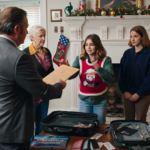
My Grandma Left Me Her $50M Hotel Empire, But Mom’s New Husband Took Control, Then Grandma Did This
On her twenty-first birthday, Olivia Monroe inherits her grandmother Evelyn’s fifty-million-dollar hotel empire. Her mother, Catherine, and stepfather, Derek, immediately try to seize control. When Olivia refuses, their greed finally shows its teeth.
Working with her grandmother, Olivia uncovers a massive embezzlement scheme run by Catherine and Derek. At a dramatic family dinner, Evelyn and Olivia present undeniable evidence of fraud, just as the police—called by Evelyn—arrive to arrest the couple. Left with the company, Olivia takes over as CEO, free to rebuild the family legacy on honesty and integrity, and finally discovers her own strength.
On my twenty-first birthday, my grandmother, Evelyn, gave me her entire fifty-million-dollar hotel empire.
She didn’t just hand me a ceremonial key. She gave me a leather folder stuffed with deeds and documents.
“It’s yours now, Olivia,” she said.
I didn’t even have time to say thank you before the front door swung open.
My mother, Catherine, and her new husband, Derek, walked in. They always knew how to ruin a moment.
My mother’s eyes locked onto the folder in my lap.
“What a gift,” she said, her voice like smooth glass. “Of course, we will manage it together as a family.”
I knew exactly what she meant. She wanted control.
“No,” I said. My voice was quiet, but it was firm.
Catherine’s face went cold.
“Then pack your bags and get out of this house,” she said. Just like that. Throwing her own daughter out like I was a guest whose time was up.
She expected me to break. To beg. To apologize.
I just sat there. I looked at my grandmother, who was watching my mother with a calm, patient stillness. My mother thought she was winning. She didn’t realize my grandmother never started a fight she hadn’t already won.
Before we dive in, make sure to like this video, subscribe to the channel, and drop a comment below telling me where in the world are you watching from.
To everyone in Portland, the Monroes were perfect. We weren’t just a family; we were a brand. Our pictures were in local magazines. We sat in the front row at charity galas. We hosted the governor’s Christmas party. Our smiles were always polished. Our clothes were always perfect.
We looked like we had no problems at all.
That was a lie.
The perfect family was a hollow shell. Inside, we were broken. We weren’t built on love or support. We were built on vanity. We were built on what other people thought of us.
My grandmother, Evelyn, was different. She was the one who built everything, and she built it right. She started with one small roadside inn just after college. She told me stories about how she scrubbed the floors herself and checked in guests at the front desk. She didn’t have family money. She had a deep, quiet discipline. She worked while everyone else was sleeping. She bought the hotel next door, then the one down the street, then the one in the next city. She built Monroe Hospitality from nothing.
She respected the work. She respected the money because she had earned it.
My mother, Catherine, was nothing like her. My mother inherited my grandmother’s charm but none of her discipline. She was beautiful and she knew it. She loved being “Catherine Monroe.” She loved the parties, the attention, the easy-access credit cards. She never worked a real day in her life. She saw the hotel empire as her personal bank account. She didn’t see thousands of employees or a legacy. She just saw what it could buy her.
My father, Daniel, saw this. He was a simple man, a professor. He loved my mother once, but he couldn’t live with her ego.
I remember their fights. They were always quiet, but they were sharp.
“Catherine, that’s enough,” he would say. “We don’t need another painting. We don’t need another party.”
“We deserve it, Daniel,” she’d answer. “We have to maintain our image.”
“I don’t care about the image,” he’d say. “I care about the people in this house.”
But she didn’t. She cared more about the photographer from the local paper than she cared about me or my dad.
When I was ten, I won the state-level architecture competition for my age group. I had built a model of a bridge. I was so proud. I ran to show her. She was on the phone planning a fundraiser.
“That’s nice, Olivia,” she said, not even looking at it. She waved her hand. “Put it in your room. Mommy is busy.”
My father saw that. He found me in my room an hour later, crying. He sat on the floor with me for hours. He helped me fix a piece of the model I had broken.
“Your mom? She’s just focused on other things right now, Libby,” he said.
But “other things” were always more important than me.
My father left a year later. He said he was tired of my mother’s ego, tired of competing with her reflection in the mirror. He moved to Boston. I only saw him on some holidays. My mother told everyone the split was amicable. She told them he just couldn’t keep up with her world. She made him sound weak.
But I knew the truth. He was the strong one. He was the only one who saw the family was sick and decided to leave.
I was left behind in the middle of it. I became my mother’s prop. She would dress me up, take me to events, and smile for the cameras.
“My daughter Olivia,” she’d say. “She’s going to be an architect. Isn’t that interesting?”
But when the cameras were gone, she was gone. She was on her phone or in her room or out with her friends. I was raised by my grandmother and our housekeeper, Maria.
Then, two years ago, Derek Hayes arrived.
He came in as a “consultant” for the hotels. My mother hired him. He was smooth. He had a perfect smile, expensive suits, and a voice that sounded like he was always selling you something. He told my mother everything she wanted to hear.
“Catherine, you are the real brains of this operation,” he’d say. “Evelyn built the house, but you—you are the one who made it a home. You have such vision. You were wasted just doing charity work.”
She ate it up.
Six months later, they were married.
I hated him from the first day. He had hollow ambition. You could see it in his eyes. He didn’t care about the hotels. He didn’t care about my mother. He cared about the Monroe name and the money that came with it. He was a parasite, and my mother had invited him right in.
He walked around the house like he owned it. He’d pick up my grandmother’s antiques and squint at them.
“We could probably get a pretty penny for this,” he’d murmur.
He talked about “synergy” and “leveraging assets.” He was all buzzwords and no substance.
My grandmother saw him too. She was polite, but she was cold. She watched him the way you watch a snake that has slithered into your garden.
And now here they were—my mother and her new husband—standing in my grandmother’s living room, trying to take what was mine. This perfect family, this perfect lie, was finally cracking open, and I was standing right on the fault line.
That night, my birthday became the worst dinner of my life.
It wasn’t a celebration. My mother and Derek turned it into a corporate meeting, a hostile takeover. They weren’t my family. They were investors, and I was a problem they had to manage.
We sat at the long polished mahogany table. My grandmother, Evelyn, sat at the head as always. I sat on her right. My mother and Derek sat across from me. They looked like a team. They were smiling, but their eyes were hard.
The leather folder with my name on it sat on the table next to my plate. It felt like a target.
Derek cleared his throat after the first course.
“Olivia,” he said, folding his hands. His voice was so reasonable, so slick. “First, happy birthday. This is a huge day, a huge responsibility.”
“Thank you,” I said.
“Fifty million dollars,” my mother chimed in. She laughed, a light, airy sound that didn’t reach her eyes. “That’s a lot of money for a college student, even a smart one.”
She patted my hand across the table. It was supposed to look loving. It felt like a trap.
“You’ll need guidance, of course,” Derek said, grinning. “Which is why your mother and I have been talking. We’ve drawn up a simple proposal.”
He reached for his briefcase, but my grandmother lifted a hand.
“We don’t do business at the dinner table, Derek,” she said. Her voice was quiet, but it stopped him.
“This is family, Evelyn,” Derek said, trying to smile. “This is just a family discussion.”
“It can wait until after dessert,” she replied.
She went back to eating her soup.
The silence was awful. My mother stared at my grandmother. Derek’s smile was frozen on his face. I wanted to disappear. I wanted to take my folder and run back to my dorm room. I kept hearing my mother’s earlier words: Pack your bags and get out. She had said it so easily. She would throw me out of my own home for money. For control.
This wasn’t about guidance. This was about greed. They were here to take my inheritance.
After dessert was cleared, Derek didn’t wait. He pulled out a stack of papers from his briefcase.
“As I was saying,” he said, sliding them onto the table, “a management team. Think of us as your advisers, your partners.”
I looked at the pages. They were full of legal words I didn’t understand: consolidated management, fiduciary oversight, joint power of attorney.
“What does this mean?” I asked.
“It just means we help you,” my mother said quickly. “We handle the day-to-day. You’re in school, Olivia. You can’t be worried about payroll and vendor contracts. It’s boring.”
“I’m studying architecture and design,” I said, my voice shaking a little. “I… I wanted to help with the new hotels. The designs—”
Derek laughed, a short, sharp, ugly sound.
“That’s cute,” he said. “That’s a very cute hobby. But this is a fifty-million-dollar corporation. We’re talking about liquidating non-performing assets. We’re talking about leveraging the brand.”
“Leveraging the brand?” I asked. “What does that mean?”
“It means,” my mother replied, her patience clearly gone, “that we sell off the smaller hotels, the ones your grandmother is so sentimental about. They’re a drain. We rebrand the flagships. We make this company lean and modern. We can double its value in five years.”
I looked at my grandmother. She was talking about selling the first inn—the one my grandmother built with her bare hands.
“No,” I said.
My mother’s eyes snapped to mine.
“What did you say?”
“No,” I repeated, laying my hand on the leather folder. “Grandma gave this to me. Not to us. To me. And I’m not selling the first inn.”
The mask of the loving, supportive parent fell away from my mother’s face. She looked hard and sharp.
“You are a child,” she hissed. “You have no idea what you’re doing. You will ruin this company. You will ruin us.”
“Us?” I asked. “You mean you and Derek?”
“We are a family!” she shouted, slamming her hand on the table.
“Then stop acting like you’re trying to rob me!” I shot back.
“Olivia.” My grandmother’s voice cut through the room like a knife.
I stopped. My mother turned, surprised. Evelyn Monroe looked at her daughter and at Derek. Her face was calm, but her eyes were ice.
“Catherine,” she said, “you have forgotten your manners. You are a guest in this house, and you have just insulted your daughter on her birthday.”
My mother’s mouth opened and closed.
“Derek,” my grandmother continued, “put your papers away. You are not our financial adviser. You are my daughter’s husband. You should try to remember that.”
She stood up.
“Dinner is over. Olivia, bring your folder. Come with me.”
I grabbed the folder and followed her. I could feel my mother’s eyes burning into my back. As we walked out, I heard Derek whisper to her, “It’s fine. She can’t do anything without signing. We’ll get her.”
They didn’t even care that I could hear them. They weren’t here to help. They were here to take. And they thought I was too young and too weak to stop them.
I didn’t sleep that night. I sat in my old bedroom with the leather folder in my lap. I could hear my mother and Derek down the hall. They weren’t shouting; they were whispering. It was a low, angry murmur that went on for hours. It sounded like plotting.
I felt sick. This was my home. That was my mother. But I felt like a stranger. I felt like prey.
I was twenty-one, and I had just been given a huge gift, but it felt like a curse. It felt like someone had painted a target on my back.
I must have fallen asleep around four in the morning, still in my clothes. When I woke, the sun was just starting to rise. The house was quiet. Too quiet.
I slipped out of my room. The door to my mother and Derek’s room was open. The bed was made. They were already up. A knot of panic tightened in my stomach.
I crept downstairs. The kitchen was empty. The living room was empty.
Then I heard it—whispering—from my grandmother’s study.
I walked slowly, my bare feet silent on the thick carpet. The study door was almost closed but not all the way. I stood in the shadow of the hallway and listened.
It was them.
“The old woman has everything locked down,” Derek was saying. His voice was low and tight. “The main accounts, the trusts. But the local vendors, the renovation budgets—there’s room there. There’s always room.”
“What about Olivia?” my mother asked. “She won’t sign. Not after last night.”
“She’s a kid,” Derek spat. “She’s emotional. We’ll give her a day or two to calm down. We’ll apologize. We’ll tell her she’s right, that we just want to help her learn the ropes. We get her to sign a simple power of attorney, just to help with the paperwork. Once we have her signature, we can move. And Evelyn… Evelyn is old. She’s sharp, but she’s old. She can’t watch everything.”
I leaned closer and peered through the crack. They stood at my grandmother’s desk with papers spread everywhere. They were rifling through her ledgers.
My ledgers now.
My mother picked up a sheet.
“What’s this?”
“That’s the new budget for the coastal hotels,” Derek said. “Rebranding. I put this proposal together last month.”
“It looks expensive,” my mother said.
“It is,” Derek replied with a laugh. “And half of it is going straight to my new consulting firm.”
I felt the blood drain from my face.
They weren’t just planning to take control. They were already stealing.
Then Derek’s phone vibrated. He picked it up, and his voice shifted into that slick salesman tone.
“Yes, hello,” he said, walking toward the window with his back to the door. “Yes, I’m looking at the numbers now. It’s a gold mine. No, no, the girl is not a problem. She’s irrelevant. We just need the transfer signed. Once that’s done, she’s out. Completely irrelevant.”
Irrelevant.
He was talking about me. And my mother was standing right there, letting him.
She was letting this man call her daughter irrelevant.
I couldn’t breathe. My chest felt like it was collapsing. I backed away slowly, careful not to make a sound. Then I ran—to the other side of the house, to the sunroom where my grandmother always had her morning coffee.
I burst in.
“Grandma,” I whispered, terrified.
Evelyn was sitting at her small desk, typing calmly on her laptop. She wore a silk robe, her white hair perfectly in place. She looked up, and she didn’t look surprised at all. She just looked patient.
“They’re in your study,” I blurted. “They’re going through your desk. They’re… they’re stealing.”
I told her everything. The whispers. The power-of-attorney trick. The consulting firm. And I told her the part that hurt the most.
“He called me irrelevant,” I said. My voice cracked. “He said I was irrelevant. And my mother, she just stood there. She just let him.”
I was crying now—hot, angry, humiliated tears.
My grandmother closed her laptop and stood. She walked over to me. She didn’t hug me—she wasn’t a cuddly person—but she handed me a tissue.
“Wipe your face, Olivia,” she said. Her voice was firm but not unkind.
I did.
“I know,” she added.
“You know?” I stared at her. “You know they’re in there? You know they’re stealing?”
“I suspected,” she said. “I have been waiting for them to get sloppy. I have been waiting for them to get arrogant. Greed always makes people arrogant, and arrogance makes them sloppy.”
“What do we do?” I asked. “We have to stop them. We have to call the police.”
“Not yet,” she said. “A quiet discovery is not enough. We need proof. We need a plan.”
She looked me in the eyes. Her gaze was clear and strong.
“They think you are irrelevant, Olivia. They think you are a child. They think you are weak.” She put a hand on my shoulder and gave a small, cold smile. “Good. Now they’ll show us exactly who they are, and we will be ready.”
My grandmother’s sunroom became our war room.
For the next eight hours, we didn’t move.
My grandmother was no longer just a sweet old lady. She was a general, and I was her new soldier.
“This is not a game, Olivia,” she said, pulling a heavy, old-fashioned ledger from a locked cabinet. “Your mother and Derek are not just greedy. They are criminals. The only way to stop them is to prove it completely, without any doubt.”
“What are we doing?” I asked.
“You are going to get an education,” she said. “A real one. Forget your architecture books for today. You are going to learn how to read a balance sheet. And more importantly, you are going to learn how to read people.”
She opened her laptop and gave me a password.
“This is the main server for Monroe Hospitality. All of it. Every invoice, every contract, every bank transfer for the last ten years. I am the only one with full access. And now so are you.”
I sat down. My hands were shaking.
“Start with Derek’s consulting firm,” she said. “He created it two months after he married your mother. Hayes Strategic Solutions. It sounds very important, doesn’t it?”
I typed it in.
There it was—a shell company. The address was just a P.O. box.
“Now cross-reference that name with our accounts payable,” she said, sliding the ledger toward me. “Look for vendor payments.”
I spent an hour digging and found them.
“Payments,” I whispered. “So many payments. Grandma, look at this. Monthly payments—$50,000 every month—for consulting fees.”
“And what services did he provide?” she asked, not looking up from a stack of bank statements she was marking with a red pen.
“It doesn’t say,” I said. “It just says ‘strategic R&D.’”
“Exactly,” she said. “He’s been siphoning money for almost a year. Your mother signed off on every payment.”
I felt sick again.
“She knew,” I whispered. “She’s been helping him steal from you. From me.”
“She’s been helping him steal from herself,” my grandmother corrected gently. “She thought this was all hers. She has no discipline. She sees money, she takes it. She doesn’t think about where it comes from or where it goes.”
We kept digging, side by side in the quiet, sunny room. It was the most time I had ever spent working with her.
I was an architecture student. I was good with numbers, with details.
“Grandma, look at this,” I said, pointing at the screen. I had pulled up the budget for the rebranding of the coastal hotels—the same one Derek had on her desk.
“This invoice,” I said. “It’s for two tons of Italian marble for the new lobby in the Bar Harbor Hotel.”
“I remember that,” she said. “Derek insisted on it.”
“I was in that lobby last semester,” I told her. “I was doing a project on hotel design. That lobby doesn’t have Italian marble. It has polished concrete. It’s beautiful, but it’s not marble.”
My grandmother’s eyes lit up.
“Pull the invoice,” she said.
I did. It was for $200,000, paid to Hayes Strategic Solutions.
“He didn’t even bother to use a different fake company,” I whispered. I felt dizzy. This was so much bigger than I’d thought. This wasn’t just a few thousand dollars. This was millions.
We found more: fake invoices for new linens that were never delivered; contracts for marketing that went to another P.O. box Derek controlled; inflated budgets for charity events with half the money disappearing; and my mother’s signature on all of it.
Hours passed. The sun began to sink, casting long shadows across the room. We had a stack of printed bank transfers, a pile of forged invoices, a clear, undeniable map of their corruption.
My grandmother sighed and leaned back in her chair. She looked tired, but resolved.
“Sometimes,” she said softly, “the best way to expose corruption is to let it think it’s winning. You have to give them enough rope, Olivia. They will always, always hang themselves.”
“They… they hate me,” I said. It sounded stupid after everything we’d uncovered, but it was all I could feel. “My own mother…”
“No, Olivia,” she said, turning to face me. “They don’t hate you. They don’t even see you. You are irrelevant. You are just a thing in their way. They don’t hate you. They hate that they don’t have this.”
She tapped the leather folder on the table.
She closed her laptop and gathered all the papers we’d printed into a neat stack, sliding them into a new black folder.
“We have the evidence,” I said. “What now? Do we call the police?”
“Not yet,” she replied. “They are arrogant. They think they are in control. They think you are a weak, emotional child. They think I am a frail old woman.” She stood and looked out at the setting sun. “By now, they’ll have a new plan. They will be feeling confident. They will come back tonight.”
“They will?” I asked, terrified.
“Oh yes,” she said. “They will come back to apologize. They will come back to make things right. They will come back to try and trick you into signing their papers.”
“What do we do?”
My grandmother turned from the window. Her face was calm, but her eyes were steel.
“Tonight,” she said, “we are having dinner at seven. And you and I will be ready for them.”
The last hour before dinner was the longest of my life.
I went to my room to get ready. It felt strange, like putting on a costume. I was supposed to be a victim, the irrelevant little girl. But I was also supposed to be a warrior.
I didn’t feel like either. I just felt like a twenty-one-year-old girl who wanted her mother to love her. But that was a different story, and it was never going to happen.
I chose a simple dark blue dress. No jewelry. I brushed my hair and left it down. I looked at myself in the mirror. My eyes were red. I looked tired and scared.
Good, I thought. Let them see it. Let them think they’re winning.
I walked downstairs at 6:45 p.m. My grandmother was already in the dining room, standing by the window. She wore a cream-colored cashmere dress. She looked beautiful and powerful in a quiet way. She was calm. Her calmness made me feel a little stronger.
“They are on their way,” she said, still looking outside.
“How do you know?” I asked.
“I can feel it,” she said. “Arrogance always arrives on time. They think they have a new plan. They think they’re going to fix the mess they made last night. They think they can still trick you.”
“Can they?” My voice was a whisper.
“No,” she said, turning to me. “Because you are not going to say anything. You are just going to listen. You are going to let them talk. People who are lying always talk too much. They need to fill the silence. We don’t. We have the truth.”
She walked to the table and touched the back of a chair.
“We will let them say everything they need to say. We will let them show us their entire plan,” she said. “And then, when they are finished, I will show them ours.”
The table was set for four. Maria had made a roast. The house smelled warm and inviting, like a normal family dinner, but it was a lie. It was a stage.
At exactly 7:00 p.m., the doorbell rang. My heart jumped into my throat. I looked at my grandmother.
“Stay calm, Olivia,” she said. “Remember who you are. You are a Monroe. And you are my granddaughter.”
Maria let them in. My mother, Catherine, and Derek walked into the dining room. They were not smiling. Their faces were appropriately serious, like they were attending a funeral.
It was all an act.
“Catherine. Derek,” my grandmother said, her voice perfectly even. “Thank you for coming.”
“Evelyn,” Derek said, nodding. He was holding his briefcase. Always the briefcase.
My mother came straight to me, putting her hands on my arms. Her face was full of fake worry.
“Olivia, baby,” she said, her voice soft and thick with fake tears. “We are so, so sorry about last night. We were just shocked. It was all too much.”
I just looked at her. I didn’t say anything. I remembered my grandmother’s instruction: Let them talk.
“We were wrong,” Derek added, stepping beside her. He looked at me with his best sincere eyes. “We came on too strong. We were just worried about you. This is such a huge responsibility. We just want to help.”
“Let’s sit down,” my grandmother said. “Dinner is ready.”
We sat. For the first twenty minutes, they ate. I just pushed a piece of potato around my plate. I couldn’t swallow. My stomach was a hard, cold knot.
Derek and my mother talked about the weather, my college classes, my architecture program. It was all so normal, so horribly fake. They were pretending they hadn’t tried to steal from me. Pretending they hadn’t called me irrelevant.
“The roast is wonderful, Maria,” my mother called out toward the kitchen.
I watched her. She was a perfect actress—charming, beautiful—and a thief. A liar. And my mother.
When Maria cleared the main course, Derek put his napkin down and leaned forward. His face shifted into business mode.
“Okay,” he said, like he was opening a meeting. “Let’s be transparent.”
That word made my skin crawl.
“We had a long talk, your mother and I,” he said, looking at me. “And we agree: you’re twenty-one, you’re an adult. This is your inheritance. You should be in charge.”
I glanced at my grandmother. She watched him, her face unreadable.
“But,” he continued, “you are also a full-time student. You can’t be in two places at once. So, we have a new proposal.”
He reached for his briefcase.
I flinched.
“No,” my grandmother said.
Derek’s hand froze on the latch.
“No more papers, Derek,” she said. “Just use your words.”
He looked annoyed but pasted on a smile.
“Of course,” he said. “It’s very simple. We want to be your team, not your managers. Your team, your support system. Olivia, you will be the head. You will be the president. It’s your name, your face. A great PR angle—the young heiress.”
“And Catherine and I,” he went on, “we will handle the back end: the finances, the operations, the boring stuff. We will report to you. You will have the final say on everything.”
“It’s the perfect solution, baby,” my mother said, smiling at me. “You get to learn the business without the stress. We do all the hard work. You get all the credit.”
“We’ll have weekly meetings,” Derek said. “I’ll handle the finances. Catherine will oversee PR and marketing. And Olivia,” he added, turning that polished smile on me, “Olivia can observe. She can be the face of the brand.”
Their tone was polished poison. It was the same plan, dressed up prettier. They still wanted control. They still thought I was stupid.
I looked at them—my mother, smiling, desperate for this to work; Derek, her puppet master, waiting for my agreement. A cold, clear anger surged through me.
“Observe,” I repeated quietly.
“Yes,” Derek said, his smile widening. “It’s the best way to learn.”
“And what about my hobby?” I asked. “My architecture?”
Derek’s smile faltered.
“What?”
“You said my architecture was a cute hobby,” I reminded him. “Where does my cute hobby fit into this plan?”
My mother’s face hardened.
“Olivia, don’t be difficult.”
“I’m not being difficult,” I said. “I’m asking a question. You want me to be the face. You want me to observe. You want to handle the finances. It sounds exactly like your plan from last night. It sounds like you just want my signature.”
“That’s not fair,” my mother said. “We are trying to help you. We are trying to be a family.”
“A family doesn’t call their daughter irrelevant,” I said.
The color drained from Derek’s face. He knew. He knew I had heard him.
“A family doesn’t try to get their daughter to sign papers she doesn’t understand,” I added.
“Now wait a minute,” Derek said, his voice going hard.
“No. I’m done,” I said. “I’m done listening to this.”
I looked at my grandmother. She was smiling—a small, proud smile.
Evelyn lifted her wineglass and swirled the red liquid.
“Well, Derek,” she said, her voice as smooth as glass, “you said you wanted to be transparent. You said you wanted full disclosure.”
She reached down beside her chair and lifted a different folder. Not my leather one. This one was thick, black, and heavy. She set it in the center of the table.
“Then you’ll have no problem,” my grandmother said, “with this full disclosure.”
The black folder sat there like a bomb.
My mother stared at it.
“What is this?” she asked sharply. The apologetic mother was gone.
Derek didn’t speak. He just watched the folder. He knew this wasn’t a new proposal.
“You wanted to talk about finances, Derek?” my grandmother said lightly. “I thought we could help you. So Olivia and I did some backend work of our own. Didn’t we, Olivia?”
I nodded. I couldn’t trust my voice.
“We looked at your consulting firm,” my grandmother continued. “Hayes Strategic Solutions. It sounds very impressive, but it’s just a P.O. box in a strip mall, isn’t it?”
Derek’s face turned white. He looked like a statue.
My grandmother opened the folder.
“Let’s start,” she said, “with the rebranding of the coastal hotels.”
She pulled out the first paper—an invoice I recognized.
“This,” she said, sliding it across the table to Derek, “is an invoice for $200,000 for two tons of Italian marble for the Bar Harbor Hotel.”
She tilted her head.
“That’s a lot of marble. The strange thing is, I was just at that hotel last week. The lobby is polished concrete. Very modern. Very not marble.”
“I don’t know what you’re talking about,” Derek said. His voice was too high.
“Oh, I think you do,” my grandmother replied. “Because the invoice was paid to Hayes Strategic Solutions. Your company.”
She pulled out another paper—a bank statement.
“And here is the payment,” she said, “signed by my daughter, Catherine.”
My mother stared at the paper. Her hand shook.
“I… I sign a lot of papers,” she stammered. “Derek handles the budgets. I trust him.”
“You trust him?” Evelyn asked. It wasn’t a question. “Did you trust him when you signed this one?”
She slid another invoice over.
“Marketing fees,” she read. “Seventy-five thousand dollars for a campaign that never ran. And another—linens, twenty thousand dollars for five-thousand-thread-count sheets. Our hotels use eight-hundred-thread-count. Where are those sheets, Derek?”
Page after page, invoice after invoice, bank transfer after bank transfer. It was all there: a map of their greed. Fake companies, inflated budgets, money siphoned, stolen, laundered. My mother’s signature was on every single one.
My mother’s face drained of color. She wasn’t an actress anymore. She was trapped.
“He… he told me it was normal,” she whispered. “He told me it was just moving money around for taxes, for… for efficiency.”
“Efficiency?” my grandmother repeated. “You call this efficiency, Catherine? This is fraud. This is embezzlement. This is stealing from your own family, from your own daughter. Because this—” she tapped the folder—“this is all Olivia’s money you’ve been stealing.”
“You had no right!” my mother suddenly screamed.
She wasn’t pointing at Derek. She was pointing at my grandmother.
“You had no right to spy on me! You had no right to go through my things!”
The room went silent. I stared at her. Her face was twisted. She wasn’t angry that she had been caught stealing. She was angry that someone had looked.
“I had every right,” my grandmother said. Her voice turned to ice. “This family name was built with honesty. I built it with my own two hands while you were out spending money you never earned. I had every right to protect this company, and I had every right to protect my granddaughter.”
“This is—” Derek started, clearing his throat, trying to summon his salesman charm. “This is a misunderstanding. A simple accounting error—”
“You are a very smooth talker, Derek,” my grandmother said. “You fooled my daughter. You fooled a lot of people. But you did not fool me. Not for one second.”
Derek’s smile finally died. His face went blank. The trap had closed, and he knew it.
“You stupid woman,” he hissed at my mother. “You were supposed to control her.”
My mother just stared at him, open-mouthed.
“I tried,” she whispered. “I tried.”
I looked at her—this woman who had helped a stranger steal from her own mother and her own daughter. She had chosen him over me. And now he had turned on her.
I felt nothing. Not sadness. Not anger. Just emptiness. She had made her choice.
My grandmother closed the black folder. The thud sounded final.
“You are right about one thing, Derek,” she said. “This was a misunderstanding. You misunderstood who was in charge.”
She looked at my mother.
“And you,” she said, her voice thick with sadness, “misunderstood what a family is.”
My mother began to cry. They weren’t tears of remorse. They were tears of pure, selfish rage.
“What are you going to do?” she demanded. “Call the police? Have your own daughter arrested?”
“What happens next,” my grandmother said, “is not up to me. It is up to the law. But first, there is one last piece of business.”
She reached down again and pulled out one more document—a single sheet in a clear plastic sleeve. She didn’t slide this one across the table. She held it.
“When I gave Olivia her inheritance yesterday,” my grandmother said, “I gave her the hotels, the properties, the legacy. But the control of the corporation, the parent company? That was still mine. I wanted to see what you would do. I wanted to see if you had changed, Catherine.”
She looked at my mother.
“You have not.”
“I can change,” my mother cried. “I can. Just—just give me another chance. We can fix this. Derek, tell her we can pay it back—”
Derek just stared at the table. The smooth, charming man was gone. He was an empty shell.
“There is no we, Catherine,” my grandmother said. “There is no fixing this. There is only accountability.”
She looked at me.
“Olivia,” she said.
My heart pounded.
“I was going to wait,” she said. “I was going to train you. I was going to let you finish school. I wanted you to be a child for a little while longer. But they”—she nodded at my mother and Derek—“have forced my hand. They have forced you to grow up too fast. So I will trust that you are ready.”
She held the paper out to me.
“This,” she said, “is the final transfer.”
I took it and read it. My hands were shaking so hard I could barely make out the words. It was a legal document signed by my grandmother, dated that morning.
“Effective immediately,” my grandmother said, her voice ringing through the room, “all control of Monroe Hospitality—all trusts, all holdings, and all financial authority—transfers to Olivia Monroe. She is the sole officer. She is the CEO. She is in charge.”
I stared at the paper. I stared at her.
“Furthermore,” my grandmother added, her gaze locking onto my mother, “as of 7 p.m. tonight, you, Catherine Monroe Hayes, and you, Derek Hayes, are removed. You are removed from all trusts. You are removed from all bank accounts. You are removed from the board. You have no authority. You have no access. You have no inheritance. You have nothing.”
My mother let out a sound. It was not a cry. It was a wail—the sound of someone who had just lost everything.
“You can’t,” she sobbed. “You can’t do this. I am your daughter. I am your only daughter.”
“I already did,” my grandmother said calmly. “I signed it this morning.”
“I won’t let you!” my mother shrieked.
She lunged—not at my grandmother, but at me, at the paper in my hand. I recoiled, nearly tipping my chair. But my grandmother was faster. She stepped in front of me and placed a hand on my mother’s chest. She didn’t shove. She just stopped her.
“That is enough, Catherine,” she said.
“Give me that!” my mother screamed, struggling to reach me. “That is mine. He made me do it, but it’s mine!”
She was a different person now—her face red, her perfect hair a mess. The mask was gone. This was the real Catherine.
“It was never yours,” my grandmother said. “You never earned it. You never respected it. And now you will never touch it again.”
My mother collapsed into her chair, sobbing these horrible, gulping, selfish sobs. Derek just sat there, staring at the table. He didn’t comfort her. He was a rat on a sinking ship, waiting for the water to close over his head.
I looked down at the paper in my hand. I was the CEO. I was in charge.
I felt sick. I didn’t feel powerful. I felt exhausted. I felt alone.
Then I heard a sound outside—a car on the long gravel driveway. Moving slowly. I looked out the window and saw flashing lights—blue and red—flickering through the trees, coming closer to the house.
I looked at my grandmother. My heart stopped.
“Grandma?” I whispered.
My mother looked up, her face streaked with tears and panic.
“What is that?” she asked. “You called the police? You called the police on me? On your own daughter?”
My grandmother walked to the front window and pulled back the curtain. She watched the approaching car.
“No, Catherine,” she said softly, her back to us. “I didn’t call the police.”
She turned around, her face full of a terrible, quiet sadness.
“I called accountability.”
The doorbell rang. It wasn’t frantic. Just two firm, steady chimes.
My mother went silent. You could hear the clock ticking on the mantel. You could hear Derek’s fast, shallow breathing.
My grandmother didn’t ask Maria to get the door. She went herself. We heard her footsteps in the hall. We heard the heavy front door open.
“Good evening, officers,” she said, her voice calm and low. “Thank you for coming. They are in the dining room.”
Two uniformed officers walked in. They were tall and filled the doorway. Behind them was a man in a suit.
My mother made a small choking sound, like a trapped animal.
“Catherine Monroe Hayes,” the first officer said. His voice was polite, but it wasn’t a question.
My mother just stared.
“Derek Hayes,” he continued.
Derek finally moved. He slowly raised his head. He looked like an old man.
“Yes,” he whispered.
“Please stand up,” the officer said.
Derek stood slowly, like he was in a dream.
“No,” my mother said. “No, this is a mistake. A family misunderstanding—”
“Ma’am, please stand up,” the officer repeated, his voice harder this time.
“Catherine,” my grandmother said from the doorway. “Stand up.”
My mother looked at her, eyes wide with a new kind of terror. This was real.
She stood. Her legs shook.
The man in the suit stepped forward. He looked at my grandmother, then at the officers.
“Proceed,” he said. He was probably a detective or from the district attorney’s office.
The first officer pulled out a piece of paper.
“Catherine Monroe Hayes and Derek Hayes,” he read. “You are under arrest for fraud, embezzlement, and conspiracy to commit fraud.”
The words hung in the air—fraud, embezzlement, conspiracy. This wasn’t just a family fight. This was a crime.
The second officer stepped toward Derek with handcuffs. Derek didn’t resist. He just turned around and put his hands behind his back. He looked almost relieved, like the performance was finally over. The salesman was gone; all that was left was a coward and a thief.
The cuffs clicked. That sound—I will never forget it. It was so final.
Then the first officer moved toward my mother.
“No!” she screamed. “No, you can’t! You can’t do this to me! I am Catherine Monroe. Monroe! Do you know who I am?”
“Ma’am, please put your hands behind your back,” the officer said patiently. He’d clearly seen this before.
“This is my house! This is my family!” she cried, hysterical.
She turned on my grandmother, all her anger and fear and greed pouring out.
“You!” she shrieked. “You did this! You would do this to your own daughter!”
Her voice was full of something like betrayal. But she hadn’t been betrayed. I had. My grandmother had. My mother had just been caught.
My grandmother stood in the doorway, looking so old, so tired—and so strong. She looked at her daughter, her only child, her beautiful, broken, selfish child.
“No,” my grandmother said, her voice soft but filling the room. “I didn’t do this.”
She held her daughter’s gaze, eyes full of a lifetime of pain.
“My daughter,” she said, “did this to herself.”
The fight drained out of my mother. Her shoulders slumped. The officer took her arm, firm but not cruel, turned her around, and she put her hands behind her back.
Click.
My mother, in handcuffs, in my grandmother’s dining room.
They led Derek out first. He didn’t look at anyone. Then they led my mother. As she reached the doorway, she stopped and looked at me. I was still at the table, still holding the piece of paper that made me CEO.
“Olivia,” she whispered. “You… you could fix this. You’re in charge now. You could… you could tell them to stop.”
Even now, she was still trying to use me, to get me to save her.
I just looked at her. I didn’t say a word. I had none left.
She stared at me for a long moment. Something in her face changed. The begging vanished, replaced by a cold, hard hatred—a hatred I knew would last forever.
“Come on, ma’am,” the officer said, and led her away.
We heard the front door open, their footsteps on the stone path, car doors slam, then silence.
The man in the suit was still there. He looked at my grandmother.
“Mrs. Monroe,” he said, “we will need your formal statement in the morning.”
“Of course, Mr. Brain,” she replied.
He nodded and looked at me.
“Miss Monroe,” he said. “This is a difficult situation. You’re very young.”
“I’m twenty-one,” I said. My voice sounded strange.
“Yes,” he said quietly. “We will be in touch.”
He left. The front door closed—for good this time.
My grandmother and I were alone.
The dining room was a mess. Plates of half-eaten food. Empty wineglasses. The black folder of evidence. My new life on a single sheet of paper.
My grandmother walked over to the table and looked at the empty chair where my mother had been sitting. She sighed—a deep, heartbreaking sound.
Then she looked at me.
“Well,” she said. She didn’t know what else to say.
I didn’t either.
The silence that followed wasn’t angry or sad. The outline had said it would feel clean, and it did. It felt like the house had just been scrubbed. The poison was gone. The lying was over. It was just us and the silence.
It was terrible. And it was perfect.
Weeks passed. Then months. The world didn’t stop.
The charges stuck. Fraud. Embezzlement. Conspiracy. The evidence my grandmother and I had found was perfect. Undeniable.
Derek took a plea deal. He blamed my mother for everything. He said she was the mastermind. He said she forced him. He was a coward right to the end. He was sentenced to eight years in prison.
My mother fought it. She hired expensive lawyers. She claimed she was the victim. She said Derek had tricked her. She said my grandmother was senile and vindictive. She said I was brainwashed.
It didn’t work. The signatures were hers. The accounts were hers. The jury saw the truth. They found her guilty on all counts. She was sentenced to ten years.
I didn’t go to the sentencing. My grandmother did. She sat in the front row.
When she came home, I asked, “How was it?”
“It was necessary,” she said. “That’s all.”
Two weeks later, I graduated from college. I wore a cap and gown. I walked across the stage and got my diploma in architecture. My grandmother sat in the crowd and clapped.
My mother’s chair was empty. My father’s chair was empty. I felt a small, sharp pain, but it was dull. I was used to it.
The next Monday, I started my new job.
CEO, Monroe Hospitality.
I was twenty-one and terrified.
When I walked into corporate headquarters, people stared and whispered. They knew the whole story. The gossip columns had been brutal—Heiress Has Mother Arrested, Hotel Wars and worse.
I went to my new office. It was huge. It had been Derek’s office. He’d decorated it in black leather and chrome. It was cold. It felt like him.
My first act as CEO was to have all the furniture removed.
I spent my first week in the archives. I read my grandmother’s journals, her old ledgers—the real ones—from the first inn. I learned how she had built the company: with honesty, by respecting her employees, by giving people a good, clean, safe place to rest.
I wasn’t a finance expert. I wasn’t a PR guru. I was an architect. So I started there.
I started with the first inn—the one my mother and Derek had wanted to sell, the one my grandmother loved. It was old, small, and losing money.
I didn’t sell it.
I redesigned it.
I used my architecture degree. I spent six months on site, working with the construction crews. We didn’t tear it down. We rebuilt it. We kept the old bones, the solid foundation. We made it new again. Stronger.
When it reopened, it was beautiful—a perfect blend of old and new. It was a success.
We did the same with the next hotel. And the next.
I wasn’t my mother. I didn’t care about parties. I wasn’t Derek. I didn’t care about “synergy.” I was my grandmother’s granddaughter. I cared about the work.
A year after the arrests, I stood on the rooftop terrace of our flagship hotel in Portland. It was sunset. The sky was purple and orange. The hotel was full. The company was stable. Clean.
My grandmother joined me. She was seventy-five now. She looked lighter. Peaceful. She had retired. She was finally just a grandmother.
I poured two glasses of champagne.
“To new foundations,” I said, raising my glass.
She smiled and raised hers.
“To new foundations,” she echoed.
We stood there, watching the sun go down.
“I still miss her sometimes,” I said quietly. It was the first time I’d said it out loud. “The mother I wished I had. Not the one she was.”
“I know, dear,” Evelyn said. She put her hand over mine. Her hand was old but strong. “That is the hardest part. Mourning someone who is still alive.”
We were quiet again.
“Legacy,” I said, looking out at the city. “It’s a strange word.”
“What about it?” she asked.
“I used to think it was just about money,” I said. “About inheriting things. I spent my whole life watching my mother obsess over what she was owed, what her legacy was.”
I turned to look at my grandmother.
“But it’s not,” I said. “Legacy isn’t what you inherit. It’s what you protect. It’s what you build. And sometimes,” I added, thinking of that horrible night at the dining table, “it’s what you save.”
Evelyn smiled, her eyes bright.
“I am so proud of you, Olivia,” she said.
“I was so scared, Grandma,” I whispered. “That night, I was so scared.”
“I know,” she said. “But you did it. You were brave.”
“I didn’t feel brave,” I admitted.
“That’s what bravery is,” she replied, squeezing my hand. “You didn’t fight for power, dear. You didn’t fight for money.” She looked me directly in the eye. “You fought for peace, and you won.”
I looked back out at the city. The lights were coming on, one by one. My hotels. My legacy. Strong.
For the first time, I felt what the Monroe name was supposed to mean. It wasn’t ego. It wasn’t vanity. It wasn’t greed.
It was integrity. It was strength. It was truth.
And for the first time in my life, I finally knew exactly who I was.
I was Olivia Monroe, and I was finally home.
News

At My Brother’s Wedding, Dad Mocked Me “Just a Soldier” — Then an SUV Pulled Up “President Awaits You”. What happens w
At My Brother’s Wedding, Dad Mocked Me “Just a Soldier” — Then an SUV Pulled Up “President Awaits You” What…

When I Came Home from NATO Duty, I Didn’t Expect My Own Father to Drag Me Into Court. He stood b
When I Came Home from NATO Duty, I Didn’t Expect My Own Father to Drag Me Into Court He stood…

My Younger Brother Texted In The Group: “Don’t Come To The Weekend Barbecue. My New Wife Says You’ll Ruin The Whole Party.” My Parents Spammed Likes. I Just Replied: “Understood.” The Next Morning, When My Brother And His Wife Walked Into My Office And Saw Me…
My younger brother texted: “Don’t come to the BBQ.” Until my brother and wife step into my office… When your…

At the family party, my sister called me “the family failure.” Her boss only smiled and said… Skyler, the golden c
At the family party, my sister called me “the family failure.” Her boss only smiled and said… A shocking family…
At The Inheritance Meeting, My Daughter-In-Law Shouted Proudly: ‘My Father-In-Law Left Us The Seven Miami Houses. Ella, Too Bad, You Only Got The Shed In Mississippi.’ Everyone Applauded. I Just Smiled And Said: ‘Son… You Really Don’t
During the Inheritance Split My Daughter-In-Law Celebrated But I Smiled: “Son, You Still Don’t Know?” The words hit me like…

My Dad Said: “STOP TREATMENT — WE WON’T APPROVE THE SURGERY.” He Signed a DNR to Take Control of My $15M Inheritance
Some fathers protect their daughters—mine tried to sign my life away. A DNR, a $15M trust, and a coma became…
End of content
No more pages to load