My Sister Demanded Half of Mom’s Inheritance for Her $75K Napa Wedding—Then Tried to Sue Me
Jasmine thought the family drama would end after burying her mother—until her younger sister and her fiancé invited her to lunch and demanded $75,000 from the house Jasmine inherited. But that was just the beginning. What started as emotional guilt-tripping escalated into legal ambushes, public smears, and weaponized nostalgia…
At a lavish engagement party filled with lies and gold-plated cutlery, Jasmine walks in with a secret recording and a plan. What unfolds changes everything.
Based on true Reddit-style drama. Revenge served cold—on a steakhouse platter.
The restaurant is the kind of place where they fold your napkin when you use the restroom. Crisp white tablecloths. Hushed conversations. A wine list that costs more than my monthly mortgage.
I watch Sloane slide her manicured fingers across the linen, tracing invisible patterns while she builds up to whatever this is. Her nails are perfect ovals, painted that soft pink shade that screams expensive salon. Mine are short, practical, clean. A veterinarian’s hands.
Preston adjusts his Rolex. Third time in five minutes. The metal catches the light from the crystal chandelier overhead, and I wonder if that’s intentional. If he practiced the gesture at home.
“Jasmine.”
Sloane’s voice is soft, careful. The tone she used to use when she needed lunch money, or gas money, or that time she needed $50,000 to keep the creditors from her door.
“You know Preston and I have been planning our wedding.”
I nod. Say nothing. Under the table, my phone rests in my lap. Screen dark but ready. Dean sent me a text before I left the house. Just two words.
Remember everything.
“We’ve found the most amazing venue in Napa,” Preston says. He leans forward, elbows on the table, like we’re old friends discussing a business opportunity. “Vineyard views, sunset ceremony, really exclusive.”
“It sounds beautiful,” I say.
Sloane’s eyes get that shine. The one I recognize from childhood, from all those times she stood at Mom’s bedroom door asking for just one more thing.
“It is. It’s perfect. It’s everything we’ve dreamed of.”
I wait.
“The thing is,” Preston continues, and his voice shifts, goes harder, “the venue requires a substantial deposit, and with the current market conditions, liquidating certain assets would put us at a disadvantage.”
I almost smile. He talks like someone who watched too many business shows. I happen to know his investment firm is barely holding together, that the designer suit probably came from a credit card he can’t afford.
“What Preston means,” Sloane says, reaching across the table for my hand, “is that we need help. Family helping family.”
There it is.
“We need $75,000,” Preston says. Flat. Direct. Like he’s ordering an appetizer.
The number hangs in the air between us.
I think about Mom’s house. The four-bedroom bungalow where Sloane and I grew up. The house that’s legally mine now, has been for exactly one month. One month since we buried Mom. One month since I held her hand while she took her last breath. One month since Sloane showed up at the hospital twenty minutes too late, mascara perfect, claiming traffic.
“From selling Mom’s house,” I say quietly.
“Well, yes.”
Sloane squeezes my hand. Her palm is soft, moisturized. Mine feels rough against hers.
“You got the whole house, Jasmine. It’s only fair that you share some of that value with family.”
Fair.
I remember being sixteen, my prom dress hanging in the closet, corsage wilting in the fridge. Sloane had been four years old, burning with fever, and Mom was at her second job. I stayed home. Gave my date some excuse about the flu. Spent the night pressing cool cloths to my baby sister’s forehead while she whimpered.
I remember being twenty-three, canceling a trip to Portland with friends because Sloane needed someone to cosign her first apartment lease. Being twenty-eight and draining my savings to cover her credit card debt. Being thirty-five and lying to Dean about where five thousand dollars went. Being forty-one and writing a check for fifty thousand dollars while Sloane sobbed about bankruptcy and bad decisions and promised this was the last time.
Mom’s voice echoes in my memory, weak from the cancer but firm in conviction.
Jasmine, you’ve given enough. When will it be enough?
“It’s only fair,” Preston repeats. “You got the whole house.”
What he doesn’t say: that he was there six months ago, walking through Mom’s living room while she slept upstairs, sedated on morphine. That I heard him and Sloane through the baby monitor I’d set up to listen for Mom’s breathing.
“We could knock down this wall,” Preston had said. “Open up the space.”
“And replace that ugly fireplace with marble,” Sloane added. “Something modern.”
They were planning renovations. To my mother’s house. While she was dying one floor above them.
“Mom would have wanted this for me,” Sloane says now, and her eyes fill with tears. Perfect, photogenic tears that don’t smudge her makeup. “She would have wanted to see me happy.”
My phone buzzes against my thigh. Dean’s text is short.
Stay strong.
“I can offer $15,000,” I say. My voice is steady, calm. “As a wedding gift.”
Preston actually laughs. It’s a short, sharp sound.
“That doesn’t even cover the flowers.”
Sloane’s face changes. Just for a second. The tears vanish, and something cold flashes in her eyes before she catches herself, before the mask slides back into place.
“Jasmine, please. We’re family.”
“$15,000,” I repeat. “That’s my final offer. Take it or leave it.”
The silence stretches. A waiter glides past with a tray of wine glasses. At the next table, someone laughs.
Preston’s jaw tightens. Sloane’s fingers curl against the tablecloth, those perfect nails pressing into the white linen like claws.
“You’re being selfish,” she says quietly. “After everything I’ve been through. After losing Mom.”
I stand up. Smooth my jacket. Look down at my baby sister. The one I raised more than Mom did. The one I sacrificed for again and again and again.
“Take it or leave it,” I say again.
I leave three twenties on the table for my untouched water and walk out into the afternoon sun, my phone already in my hand, already pulled up to the recording I made of Preston and Sloane in Mom’s house six months ago.
Dean was right. It’s time to remember everything.
Dean finds it on a Wednesday night. I’m sitting at the kitchen table with a mug of tea gone cold, Mom’s photo album open in front of me. Pictures of Sloane as a baby, gap-toothed at seven, radiant in her high school graduation gown. My throat aches. I keep looking for the moment it changed, when my baby sister became someone I don’t recognize.
“Jasmine.”
Dean’s voice cuts through my thoughts. He’s standing in the doorway with his laptop, his accountant face on, the one that means he’s found something in the numbers that doesn’t add up.
“You need to see this.”
He sets the laptop on the table, pushes it toward me. The screen shows a background check report, Preston Vance’s financial history laid out in merciless detail. Gambling debts. $53,000 to an offshore casino. Another $18,000 to someone called Big Tommy, which sounds like a nickname nobody wants to owe money to.
“Keep scrolling,” Dean says.
Cryptocurrency investments. Failed ones. $85,000 vanished into digital coins with names like Moonshot and Rocket Fuel. The kind of investments that promise quick riches and deliver bankruptcy.
“His family cut him off six months ago,” Dean says quietly. “There’s a court filing. His father threatened to have him declared financially incompetent.”
My hands are shaking. I think about Preston’s Rolex, his designer suit, that casual way he asked for $75,000 like it was pocket change. All of it borrowed. All of it fake.
“There’s more.”
Dean reaches over, clicks to a different tab. Text messages. A whole thread between Sloane and Preston, dated two weeks before the restaurant ambush.
Preston: The sister won’t just give us the money. We need leverage.
Sloane: I know Jasmine. Guilt works. She’s been taking care of me since I was born.
Preston: Then use it. Family obligation, dead mother’s wishes, whatever works.
Sloane: I’ll cry. That always gets her.
I read it twice. Three times. The words don’t change.
Dean’s hand covers mine. “I’m sorry.”
My phone rings. Aunt Patricia. Mom’s older sister, the one who sent a gorgeous flower arrangement to the funeral and told me how proud Mom was of me.
I answer it. “Hi, Aunt Patricia.”
“Don’t you ‘hi’ me.” Her voice is sharp, cold. “I just got off the phone with Sloane. She’s devastated, Jasmine. Absolutely devastated.”
“About what?”
“About your greed. About how you’re keeping everything for yourself while she gets nothing. Your mother would be ashamed.”
The words hit like a slap. I grip the phone tighter.
“That’s not what’s happening.”
“Sloane told me everything. How you manipulated your mother while she was sick. How you isolated her from the rest of the family. How you’re refusing to share a single penny of the inheritance.”
“None of that is true.”
“She’s your sister, Jasmine. Your baby sister. And you’re treating her like a stranger.” Patricia’s voice breaks. “I thought you were better than this.”
She hangs up.
I set the phone down carefully, like it might explode.
Dean is watching me, his jaw tight.
“She’s been calling everyone,” I say. “Hasn’t she?”
“Probably.” He pauses. “Check your Facebook.”
“I don’t want to.”
I do it anyway.
Three cousins have unfriended me. The family group chat, the one that usually shares recipes and baby pictures, has gone quiet.
No, not quiet. I scroll back. They’re still talking. They’re just not including me anymore.
Someone named Jennifer Parker, a second cousin I barely know, has posted a vague status.
It’s sad when people show their true colors after a tragedy. Family should come first.
Forty-two likes. Sixteen comments agreeing with her.
My clinic’s Facebook page has a new review. One star. Anonymous.
Dr. Williams seems caring with animals but apparently steals from her own family. Makes you wonder what else she’s capable of.
Dean reads it over my shoulder. Says a word I rarely hear from him.
“They’re destroying me,” I whisper.
“They’re trying to.” He closes the laptop. “The question is what we do about it.”
I think about Mom’s hospital room. Those last weeks when Sloane visited twice, stayed for maybe twenty minutes each time. When I slept in the chair next to Mom’s bed, held her hand through the pain, read to her when she couldn’t sleep.
The hospice nurse, Rosa, kept detailed logs. I remember her kind eyes, her gentle hands.
You’re a good daughter, she’d told me. Your mother knows that.
“We document everything,” I say slowly. “Everything they’re doing. Everything they’ve said.”
Dean nods. “I already started. The text messages, the restaurant meeting, Preston’s financial history. I’ve got it all backed up in three places.”
My phone buzzes. A voicemail from the family lawyer, Janet Morrison. I put it on speaker.
“Jasmine, this is Janet. I received a very interesting letter today from an attorney representing your sister. Sloane is threatening to contest the will. I want you to know this is completely baseless. The will is ironclad, and your mother was of completely sound mind when she made it. I’ve seen this kind of thing before. It’s a pressure tactic. Don’t let it work. Call me tomorrow and we’ll discuss next steps.”
The voicemail ends.
“They’re going to drag this out,” I say. “Make it as painful as possible.”
“Let them try.” Dean’s voice is hard. “We’ve got the truth on our side.”
I drive to the cemetery the next morning. Mom’s grave still looks raw, the grass not fully grown over the dirt. The headstone is simple, elegant. Her name, her dates, and the line she requested.
Beloved mother and friend.
I sit on the ground next to her, ignoring the damp seeping through my jeans.
“I get it now,” I tell her. “The house wasn’t just money, it was protection. You knew Sloane would do this. You knew I’d need something they couldn’t take.”
The wind moves through the trees. A bird calls somewhere overhead.
“I’m going to fight,” I say. “I’m not letting them destroy what you left me.”
My phone rings. Janet Morrison.
“I wanted you to hear this directly,” she says when I answer. “Your mother came to see me three months before she died. She updated her will specifically because she was worried about Sloane. She told me, and I quote, ‘My oldest daughter has given everything, my youngest daughter has taken everything. It’s time that ended.’”
I close my eyes. Mom knew. Of course she knew.
“Thank you,” I manage.
“There’s one more thing,” Janet says. “I’m sending a cease and desist letter to Sloane and Preston today. If they continue with this smear campaign, we have grounds for a harassment lawsuit.”
After we hang up, I stay at the grave a little longer. Then I drive to my clinic, where my partner, Sarah, is waiting with coffee and a fierce expression.
“I saw that review,” she says. “Already flagged it as false. And I called the other partners. We’re putting out a statement supporting you.”
“You don’t have to do that.”
“Yes, we do.” She hands me the coffee. “We’re family too, Jasmine. The kind that actually matters.”
That evening, three relatives call. Cousins who’ve known me since childhood. They apologize. They say Sloane’s story didn’t add up once they thought about it. They remember who was really there for Mom.
But then my phone chimes with another notification.
My cousin Rachel’s baby shower. The invitation has been rescinded.
Sloane will be there, and I don’t want any drama. I’m sorry.
Dean finds me staring at the message. He doesn’t say anything. Just wraps his arms around me and holds on while I finally cry.
Three days later, Sloane’s voice on the phone is different this time. Softer. Broken.
“Jasmine. I’m so sorry.” She’s crying. Real crying. Not the practiced tears from the restaurant. “I’ve been so stressed about the wedding. About money. About everything. I said terrible things.”
I’m standing in the kitchen, phone pressed to my ear, watching Dean load the dishwasher. He glances up, and I see the warning in his eyes.
“I just want to make things right,” Sloane continues. “Can we meet? Just the four of us. Preston wants to apologize too. We found a solution that works for everyone.”
My stomach tightens.
“What kind of solution?”
“Just come to dinner. Please. Let’s talk like family.” She pauses. “There’s this steakhouse Preston knows. Really nice. Our treat. Tomorrow night at seven?”
I should say no. Every instinct I have is screaming danger. But then she says it. The words that always work.
“Mom would want us to at least try, wouldn’t she?”
After I hang up, Dean sets down the plate he’s holding.
“You’re not actually considering this.”
“She sounded genuine. She sounded desperate.”
He dries his hands on a towel.
“This is a trap, Jasmine.”
“You don’t know that.”
“Yes, I do.” He pulls out his phone, types something. “What’s the name of the steakhouse?”
I tell him. Watch him scroll through whatever he’s reading.
“One-party consent state,” he says. “The steakhouse is across the county line.”
“So?”
“So we bring insurance.” He meets my eyes. “A phone, set to record. Just in case.”
The idea makes my chest tight.
“That feels wrong.”
“You know what else feels wrong? Your sister trying to steal your inheritance.” He sets his phone on the counter. “We’re not going to share it unless we need to. But if this goes the way I think it will, we’ll be glad we have it.”
I spend the next day practicing. Standing in front of the bathroom mirror, watching my face stay calm while Dean throws impossible scenarios at me.
“Sign this,” he says, waving a piece of paper.
“No,” I say. My voice doesn’t shake.
“Your mother would be ashamed of you.”
“Maybe.” I keep my breathing steady. “But she left me the house for a reason.”
“You’re tearing this family apart.”
“I’m protecting what she wanted me to have.”
By the time we pull into the steakhouse parking lot the next evening, I’ve got a folder in my bag. Copies of the will. The recording from Mom’s house. Affidavits from her doctor, her hospice nurse, her best friend. Everything that proves Sloane barely showed up during those final months.
The restaurant is all dark wood and leather booths. Expensive. The kind of place where even the bread basket costs more than a regular dinner.
I spot them immediately. Not Sloane and Preston at the table. Two men in suits at the bar, watching us walk in. Their posture is too alert. Too focused. They’re not here for steak.
“Lawyers,” Dean murmurs. His hand finds the small of my back.
Sloane waves from a corner booth, her smile bright and perfect. Preston stands as we approach, his Rolex catching the dim lighting. Again.
“You came!” Sloane pulls me into a hug. She smells like expensive perfume. “I’m so glad.”
The appetizers arrive fast. Too fast. Like they were already ordered. Calamari. Shrimp cocktail. Things I didn’t choose.
“We really are sorry about how things went last time,” Preston says. He’s cut his steak into precise pieces. Hasn’t eaten any of it. “Emotions were running high.”
“We’ve been thinking,” Sloane adds. She reaches for my hand across the table. “About compromise. About what’s fair for everyone.”
Here it comes.
Preston pulls papers from his jacket. Sets them beside my plate.
“We had our lawyers draw something up. Just a simple agreement.”
I look down. The words swim. Quitclaim deed. Trust paperwork. Preston’s name in too many places.
“It’s very straightforward,” Preston says. “You transfer the house into a family trust. We all benefit. Everyone gets their fair share.”
“Just sign it,” Sloane whispers. Her grip on my hand tightens. “Make this right, Jasmine. For all of us.”
Dean’s movement is calm. Deliberate. He reaches into his pocket. Pulls out his phone. And sets it on the table. Screen up. Red recording dot visible.
“No,” he says quietly.
Preston’s face goes white.
“What is that?”
“Insurance.” Dean gestures toward the bar. The two lawyers are already standing. Gathering their things. “We have enough evidence of coercion and fraud. So do the security cameras in this restaurant. Smile, gentlemen.”
The lawyers are moving fast now. One of them drops cash on the bar. They’re gone before Preston can call them back.
“You recorded us?” Sloane’s voice cracks. Not with tears this time. With fury.
People at nearby tables are turning. Watching. A woman in pearls has her phone out.
“Yes.” I pull my hand free from Sloane’s grip. “Just like you tried to ambush me.”
Preston lunges for the papers but Dean is faster. He slides them out of reach.
“You’ll want to keep these,” Dean says to me. “Evidence.”
“This isn’t over,” Sloane whispers. Sharp. Vicious. Nothing soft left in it now. “Nothing soft left in it now. You think you’re so smart. But this isn’t over.”
Preston grabs my arm as I stand. His fingers dig in.
“You can’t do this.”
Dean is between us before I can blink. His body is a wall. Solid and immovable.
“Don’t touch my wife.”
The entire restaurant has gone quiet. Even the kitchen sounds have stopped.
I look at Sloane. Really look at her. The baby sister I raised? The four-year-old with the fever? The teenager who needed lunch money?
She’s gone. Maybe she was never really there at all.
“My baby sister died,” I say. And my voice is steady. “When she chose greed over love.”
No guilt. Not anymore. Just clarity.
We walk out together. Dean’s hand warm against mine. Behind us I hear Sloane’s voice rising, Preston’s desperate explanations to the manager, the murmur of other diners pulling out their phones.
The night air is cool. Clean. I can breathe again.
“You did good,” Dean says.
The phone in his pocket has everything. Every word. Every threat. Every attempt at manipulation. And the quitclaim deed, with its impossible terms and Preston’s control clauses, is safe in my bag.
But before we reach the car, I hear footsteps. Fast. Angry.
“This isn’t over,” Sloane hisses. She’s followed us into the parking lot. Mascara streaked now. That perfect mask finally cracked. “You hear me? This isn’t over.”
Preston is behind her. Reaching. His hand catches my jacket.
Dean steps between us again. Solid. Protective.
I meet Sloane’s eyes over his shoulder.
“You’re right,” I say. “It’s not over. But it will be soon.”
We drive home in silence. The recording sits in Dean’s phone. The quitclaim deed sits in my bag. And somewhere behind us, my sister is realizing she’s already lost.
Later that night, the state bar complaint form sits on my kitchen table, crisp white paper covered in my careful handwriting. I’ve filled out dozens of medical forms in my career, but this one feels different. Each line I write is a small act of war.
Dean leans over my shoulder, reading as I type the final details into the online portal.
“You’re sure about the names?”
“Jason Mitchell and Rebecca Hartwell.” I don’t need to check my notes. Those two lawyers sitting at the steakhouse bar are burned into my memory. Licensed in this state for eight and twelve years, respectively. Both should know better than to participate in documented coercion.
The cursor hovers over the submit button. My finger hesitates.
“What Mom would want doesn’t matter anymore,” Dean says quietly. He knows what I’m thinking. That Mom always preferred peace. That she spent her whole life smoothing over Sloane’s messes, keeping family dinners civil, pretending everything was fine. “What matters is what’s right.”
I click submit.
The confirmation screen loads. Case number 2025ETH4471.
I screenshot it, add it to the folder on my desktop labeled Evidence. The folder is getting thick. Affidavits from Dr. Harrison documenting Sloane’s three visits during Mom’s six-month hospice care, compared to my daily presence. Rosa’s detailed nursing logs showing who was actually there at 2 a.m. when Mom couldn’t breathe, who changed her sheets, who held her hand. Bob’s written statement about Preston photographing the property from the sidewalk two weeks before Mom died, notepad in hand like he was already planning the renovations.
My phone rings. Unknown number. I let it go to voicemail, but the next call comes thirty seconds later. Same number.
“Answer it,” Dean says. “We’re recording everything now.”
I tap the speaker button, the recording app already running.
“This is Jasmine.”
“Ms. Williams, this is Richard Vance.” The voice is deep, authoritative, old money trying to sound reasonable. “Preston’s father.”
“I’m calling about this unfortunate situation with my son and your sister,” he continues. “I understand there’s been some tension regarding family property.”
I have. Tension. The word tastes bitter.
“Is that what we’re calling attempted fraud now?”
A pause.
“I’ve been made aware of a recording, one that my son claims was obtained illegally and is being used to threaten him.”
“The recording was made in a one-party consent state, Mr. Vance. I checked before I went to that steakhouse. Everything on that recording is legal and admissible.”
“Nevertheless,” his voice goes harder, “if that recording is shared publicly, or if you continue this harassment campaign against my son, we will have no choice but to pursue defamation charges. Preston is prepared to take whatever legal action necessary to protect his reputation.”
The laugh comes out before I can stop it. Sharp. Bitter.
“His reputation. The one where he tried to defraud a grieving woman out of her inheritance? That reputation?”
“I would encourage you to speak with your attorney, Ms. Williams, and to remember that legal battles are expensive. Protracted. I have considerable resources at my disposal.”
The line goes dead.
I stare at my phone. My hands are steady, but something cold has settled in my chest.
“He’s bluffing,” Dean says. “That was a scare tactic.”
“Maybe.”
I add the call to my timeline, noting the date, time, and content. The document is fifteen pages now. Every text from Sloane. Every social media post. Every threatening phone call. All time-stamped. All organized. All backed up to three separate cloud services.
My laptop chimes. Email notification. I almost ignore it. But the subject line catches my eye.
Thinking of you.
It’s from someone named Jennifer Walsh. I don’t know any Jennifer Walsh. I open it anyway.
The message is short. Sweet. Sympathetic.
I saw Sloane’s post about missing her sister and I just wanted to reach out. I can’t imagine how hard it must be to lose your mother and then have family conflict on top of that grief. Sloane showed me some old photos of you two together. She seems like such a loving person. I hope you can find it in your heart to forgive whatever misunderstanding has come between you. Family is so important.
I scroll down. The signature includes a link to her Instagram account.
Dean is already pulling it up on his phone. One hundred forty-seven comments on that post Sloane made yesterday. The one with the childhood photos.
I don’t need to look. I know which photos she used. The two of us at the beach. Me helping her learn to ride a bike. Christmas morning when she was eight and I was twenty. Me in my college sweatshirt. Her in matching pajamas that I’d bought with my grocery store paycheck.
Missing my sister who abandoned me, Dean reads. Who got everything and left me with nothing but memories. Mom loved us both. But Jasmine only loves herself now.
The comments are worse. Strangers calling me selfish. Greedy. A bad sister. A disgrace.
I close the laptop.
“We don’t respond,” I say. My voice sounds far away. “Not publicly.”
“Agreed.” Dean’s already typing on his phone. “But I’m sending the screenshots to our lawyer. And to your cousin Marie. She’s been asking questions.”
The rest of the afternoon blurs. Dean’s IT friend, someone named Marcus who works in digital forensics, stops by to image my hard drive.
“Preserve everything,” he says, his equipment humming on my kitchen table. “Texts, emails, social media interactions. If this goes to court, you want a clean chain of custody.”
My phone buzzes. Aunt Patricia. I don’t answer. The voicemail notification appears thirty seconds later.
“Jasmine, I just want to understand.” Patricia’s voice is thick, like she’s been crying. “Sloane showed me messages where you threatened to ruin her wedding. Where you said terrible things about Preston. She’s devastated. Absolutely devastated. I know you’re grieving, honey, but this isn’t like you. Call me, please. Let’s talk about this before it gets any worse.”
I save the voicemail, add it to the evidence folder.
“She’s lying about the messages,” I tell Dean. “I never threatened anything.”
“I know.” He’s typing furiously on his laptop now, cross-referencing dates. “Which means Sloane either fabricated them, or took real messages completely out of context. Either way, it’s more evidence of her pattern of deception.”
Evening comes. I’m at my desk, drafting emails to my cousins. Not defensive, not angry, just facts. Dates of Mom’s hospice care, documentation of who was present. Copies of the will, properly redacted. The truth, laid out simply and clearly for anyone willing to look.
I don’t send them yet. Our lawyer said to wait. To let Sloane keep digging her hole deeper while we build our case higher.
My phone rings again, this time it’s the practice. I almost don’t answer, but Dr. Sanders is a partner. I have to take his call.
“Jasmine, we need to talk about something.” His voice is careful. Professional. “We received a complaint through the state board. Anonymous. Claiming you’ve been distracted at work. That you made a medication error that endangered a patient.”
My stomach drops.
“That’s not true.”
“I know.” His voice softens slightly. “I checked. All your charts are perfect. Every medication is documented and correct. But the board has to investigate anyway. It’s procedure.”
“How long?”
“Two weeks. Maybe three. It won’t impact your work here. We all know it’s baseless. But I needed to let you know.”
After he hangs up, I sit very still.
They went after my practice. My profession. The one thing I’ve built that has nothing to do with family or inheritance or Mom’s house.
Dean finds me there twenty minutes later, still staring at my phone.
“They’re getting desperate,” he says.
I nod. Can’t speak yet.
“That’s good,” he continues. “Desperate people make mistakes. And we’re documenting every single one.”
The engagement party invitation is still on my refrigerator. Country club. Black tie optional. My name is conspicuously absent from the guest list, but we both know I’ll be there.
I pull up the recording on my phone. Listen to Preston’s voice.
Just sign the quitclaim deed, Jasmine.
Sloane’s urgent whisper. The lawyer’s footsteps retreating.
The engagement party is coming. And I’m ready.
On the day of the engagement party, the country club parking lot is full of luxury cars. BMWs. Mercedes. A Tesla that probably costs more than my entire year’s salary.
Dean pulls into a spot near the entrance, and I can see the glow of chandeliers through the tall windows. Inside, Sloane’s engagement party is in full swing.
“You sure about this?” Dean asks.
I check my phone. The recording is queued up, ready. The phone I have in my purse, fully charged.
“I’m sure.”
We walk toward the entrance together. My hands are steady. That surprises me. I expected them to shake.
A bridesmaid blocks the door before we reach it. I recognize her from Sloane’s Instagram posts. Tall. Blonde. Wearing a dress that costs more than my mortgage payment. Her smile is ice.
“You’re not welcome here,” she says.
“I’m here to show everyone the truth,” I tell her.
Her eyes narrow. She pulls out her phone, and I know she’s texting Preston.
Within seconds, a security guard appears from inside. Navy uniform, radio on his belt. He’s young, maybe twenty-five, and he looks uncomfortable.
“Ma’am, I’m going to have to ask you to leave,” he says.
Then the country club manager arrives. Older, silver-haired, wearing a suit that screams authority.
“This is a private event. If you don’t leave immediately, we’ll call the police for trespassing.”
Dean’s hand finds mine, squeezes once. Then he looks at the manager with that calm accountant face of his.
“We’re here as paying guests.”
The manager blinks.
“Excuse me?”
“We’d like to purchase drinks at the bar,” Dean continues. He pulls out his wallet, extracts his credit card. “That makes us customers, not trespassers.”
I watch the manager’s expression shift. He’s calculating, weighing the legal implications. Dean’s right, and we both know it. The country club bar is technically open to anyone who wants to buy drinks.
“Two martinis,” Dean says to the security guard. “If you don’t mind.”
The manager’s jaw tightens, but he nods at the guard.
We’ve bought ourselves time. Not much, but enough.
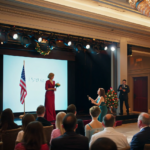
Inside, the ballroom is everything Sloane wanted. White roses everywhere. String quartet playing in the corner. Tables covered in cream linens with gold accents.
The guests are the kind of people who summer in the Hamptons and winter in Aspen. Preston’s family, mostly. His father stands near the bar, holding court with several other men in expensive suits.
We slip along the wall toward the sound system. Nobody’s noticed us yet. Everyone’s focused on the small stage at the front where Preston is adjusting a microphone.
“Can I have everyone’s attention?” Preston’s voice booms through the speakers. The quartet stops playing. Conversations die. All eyes turn to him.
Sloane appears at his side, radiant in a white cocktail dress. She’s glowing. Playing the role of beloved fiancée perfectly.
“I want to thank you all for being here tonight,” Preston continues. “Sloane and I are so grateful for your support as we begin this journey together.”
My phone is out. Dean is blocking me from view as I approach the main table and connect the auxiliary cable from the laptop to my phone.
“True love,” Preston says, his voice going soft and syrupy, “means conquering obstacles. It means standing together against those who would tear you apart. Even family members who let jealousy poison their hearts.”
Murmurs ripple through the crowd. I see Aunt Patricia nodding, dabbing at her eyes with a tissue.
“But we’ve risen above that negativity,” Preston continues. “We’ve chosen love over bitterness, forgiveness over resentment.”
I press play.
The sound fills the ballroom. Crystal clear. Unmistakable.
Preston’s voice from the steakhouse recording: “Just sign the quitclaim deed, Jasmine. We can have this done in five minutes.”
Sloane’s voice, urgent and sharp: “Just sign it, Jasmine.”
The sound of papers rustling. My own voice, calm and measured: “You brought lawyers to ambush me.”
Preston’s recorded response: “We’re offering you a fair deal for your signature.”
I watch the color drain from Preston’s face on the stage. Sloane’s mouth opens, but no sound comes out.
The recording continues. The lawyer’s voices are clear. The coercion is undeniable. Every manipulative word, every threat, every lie is exposed for everyone to hear.
“Stop that!” Sloane screams. Her voice is raw, nothing like the soft, sweet tone she’s been using all night. “Stop it right now!”
But I don’t stop. I let the entire recording play. Two minutes that feel like two hours.
When it ends, the silence in the ballroom is absolute.
Preston’s father moves first. He storms toward the stage, his face purple with rage.
“You lied to us!”
“Dad, I can explain,” Preston starts.
“You told me Jasmine was being unreasonable.” His father’s roar echoes off the walls. “You said she was keeping your inheritance. You’re cut off. Do you hear me? Cut off. And you owe us $100,000 for the deposits we already paid.”
Guests are pulling out their phones. Recording. Posting. The social media machine that Sloane used against me is now turning on her.
I see the bridesmaids backing away from Sloane. See Preston’s relatives shaking their heads. See Aunt Patricia’s face crumple as she realizes she backed the wrong sister.
“That recording is illegal!” Sloane shrieks. “She can’t use it!”
“One-party consent state,” Dean says quietly, but loud enough for the people near us to hear. “Perfectly legal.”
I unplug the phone from the laptop. Look at Sloane. Really look at her. The mask is gone now. Her face is twisted with rage and desperation.
This is who she’s always been underneath the tears and the manipulation.
“The truth always comes out,” I say.
Then I take Dean’s hand and walk toward the exit.
Behind us, I hear Sloane’s scream of rage. Hear the chaos as guests rush for the doors. Hear Preston’s father still shouting about money and lies.
We step out into the cool evening air. The parking lot looks the same as when we arrived, but everything has changed.
Dean opens the car door for me.
“How do you feel?”
I slide into the passenger seat and let out a breath I didn’t know I was holding.
“Free,” I say.
A week later, the SOLD sign went up this morning. Red letters on white, staked into the lawn like a flag of surrender. Or maybe victory. I’m not sure which yet.
I stand in the empty living room where Mom used to keep her reading chair by the window. The hardwood floors echo under my footsteps. Every sound bounces off bare walls, magnifying the silence. Sunlight streams through windows that need washing, catching dust motes in golden beams.
Dean walks past carrying the last box. Mom’s photo albums, carefully wrapped in bubble wrap. Her face smiles up from the top frame, taken at my college graduation. She looked so proud that day. Tired, but proud.
“That’s everything,” Dean says, setting the box by the front door. “You ready?”
I nod. Can’t quite speak yet.
My phone buzzes in my pocket. I pull it out, see Sloane’s name flashing across the screen. The voicemail icon appears seconds later.
Dean watches me.
“You going to listen to it?”
I tap the screen. Put it on speaker because I have nothing left to hide.
Sloane’s voice fills the empty room. Hysterical. Raw.
“Jasmine, you have to fix this. Preston’s family cut him off completely. The wedding venue is gone. Everyone knows. Everyone. You did this to me. You destroyed my life. Call me back. We need to talk about this. We’re still sisters. You can’t just abandon me like this. Mom would be so disappointed in you right now. Call me. Please.”
The message ends. The silence returns, bigger than before.
“Same manipulation,” I say quietly. “Different desperation.”
Dean reaches for my hand. Squeezes.
“You going to call her back?”
I look at my phone. At Sloane’s name in my recent calls list. At the string of missed calls and unread messages that stretches back six weeks. She tried everything. Guilt. Anger. Threats. Tears. The entire playbook we learned growing up.
I press delete. Watch the voicemail disappear.
“No,” I say. “That baby sister I raised? She became a stranger a long time ago. I just didn’t want to see it.”
Dean pulls me close. I rest my head on his shoulder and let myself feel it. Not the guilt she wants me to feel. Just the grief. The real kind. For the sister I thought I had. The one who never actually existed.
“The new practice called yesterday,” I tell him. “Everything’s confirmed. I start in two weeks.”
“And my firm approved the remote work arrangement,” Dean says. “We’re really doing this.”
Five hundred miles away. A different state. New house with a view of mountains instead of memories. A veterinary practice that doesn’t know about family drama or inheritance battles. Neighbors who won’t whisper when I walk past.
Therapy starts next month. Dr. Morrison specializes in family trauma. She says it’ll take time to unpack everything. To understand why I gave so much for so long. To learn the difference between love and obligation.
Margaret Wilson hosted a farewell dinner last week. Mom’s best friend, the one who testified about Sloane’s minimal hospital visits. She cried when she hugged me goodbye.
“Your mother would be so proud of you,” she whispered. “She gave you that house as protection. You finally understand that.”
Three cousins apologized. Said they believed Sloane’s lies at first, but the engagement party recording changed everything. They see clearly now. We exchanged new phone numbers, promised to stay in touch. Maybe we will. Maybe chosen family works better than blood family anyway.
The moving truck idles in the driveway. Dean checks his watch.
“We should go. Long drive ahead.”
I take one last look around. This room where Mom taught me to braid hair. That corner where Sloane and I built pillow forts. The kitchen where I made dinner every night while Mom worked double shifts. Good memories. Bad memories. All of them mine to carry or leave behind.
My phone buzzes again. Sloane’s number. I don’t hesitate this time.
Block contact. Delete thread.
Gone.
Dean holds the door open. Sunlight spills across the threshold, warm and bright. I step outside. Lock the door. Drop the key in the realtor’s lockbox.
We drive toward the sunrise. Windows down. Radio playing something upbeat. Dean’s hand warm in mine.
That night, in our new house with boxes still unpacked, I pull out my journal. Write by lamplight while Dean assembles furniture in the next room.
Love isn’t measured in dollars or sacrifices. Mom knew that. She gave me the house not as an inheritance but as a test. I finally passed.
Some called me selfish. I call it survival. True love requires firm boundaries against those who would exploit it.
I close the journal. Walk to the window. Mountains rise in the distance. Purple against the darkening sky. No painful memories here. Just possibility.
Dean appears beside me. Wraps his arms around my waist.
“Happy?”
I lean back against him. Feel the weight of guilt finally lifting.
“Getting there,” I say.
The boxes stayed stacked in the hallway for a week.
Dean kept stepping around them, nudging one with his foot when he thought I wasn’t looking. Not impatient, exactly. Just ready to be done with transition and move into whatever came next.
I wasn’t sure what came next.
Day three in the new house, I woke before sunrise. Old habits die hard. For six months, my mornings had been built around Mom’s medication schedule, blood pressure checks, careful note-taking for hospice. Now, the only sounds were the hum of the refrigerator and Dean’s steady breathing from the other side of the bed.
I lay there for a minute, eyes open in the dark, and waited for the old panic to kick in.
It didn’t.
Instead, something else came. A thought so quiet I almost didn’t hear it.
You survived.
I slipped out of bed, careful not to wake Dean, and padded to the kitchen. The view from the window over the sink still caught me off guard. Mountains, real ones, jagged and purple against the lightening sky. Where there should have been Mom’s maple tree and the neighbor’s rusted pickup, there were pine trees and a wide ribbon of road winding down into a valley I didn’t know yet.
I made coffee. Not the rushed, functional kind I’d been living on, but the slow kind. Whole beans ground fresh. Water just off the boil. The way Dean liked to do it on Sundays back when we still had Sundays.
The house smelled like coffee and cardboard and new paint.
At eight o’clock, my phone buzzed. Unknown local number. I almost let it go to voicemail. Old reflex. Don’t answer if you’re not braced for impact.
Then I remembered: the only people who had this number were my husband, my new clinic, and the therapist.
“This is Jasmine.”
“Dr. Williams? Hi, it’s Naomi from Riverside Animal Clinic. Just wanted to check you’re still good to start Monday.”
Her voice was bright. Normal. Nobody had pre-loaded her with a story about my alleged greed or cruelty or selfishness. To her, I was just a vet starting a new job.
“Yeah,” I said. “I’m good.”
“Great. We’re excited to have you. Dr. Patel especially—she’s been stalking your conference lectures on YouTube.”
I laughed before I could stop myself. The sound startled me.
“Tell her I promise I’m less boring in person,” I said.
“We’ll see on Monday,” Naomi teased. “See you then, Doctor.”
She hung up. I stood there with the phone still against my ear, the coffee cooling in my mug.
Doctor.
Not daughter or sister or selfish. Not the villain in someone else’s sob story.
Just… doctor.
“I want you to make a list,” Dr. Morrison said.
Her office was exactly what a therapist’s office should be. Comfortable chairs. Soft lighting. A plant in the corner that looked mysteriously healthy. No family photos on the walls, just abstract art in calming colors. A box of Kleenex within easy reach.
I’d already used three.
“Of what?” I asked.
She tapped her pen against her notepad. A small sound, not impatient. More like she was keeping time.
“Of all the roles you’ve played in your family,” she said. “And then, next to each one, I want you to write whether you chose it or it was assigned to you.”
I almost rolled my eyes. It sounded like therapy-speak, like something out of a self-help workbook.
But this was why we’d driven five hundred miles and signed a lease with a view of mountains instead of memories. If I was going to be here, I might as well do the homework.
I took the pen she offered, flipped over the corner of her legal pad, and wrote.
Caretaker.
The word came out fast. Automatic. Next to it, I wrote: assigned.
Oldest daughter.
Assigned.
Responsible one.
Assigned.
Problem solver. Financial rescuer. Emotional sponge.
Assigned. Assigned. Assigned.
Halfway down the page, I hesitated.
Vet.
Chosen.
Dean’s wife.
Chosen.
Mom’s advocate.
Chosen and assigned.
I circled that one.
“What comes up when you look at that list?” Dr. Morrison asked.
I studied it. The left side was a column of titles that had shaped my entire life. The right side was a mess of arrows.
“I let people pick my job for me,” I said slowly. “And then I did it really well. So well they forgot they ever asked in the first place.”
“And what happened when you tried to quit?” she asked.
“Sloane tried to sue me,” I said. “The family decided I was the villain. Aunt Patricia said Mom would be ashamed.”
“Do you believe that?”
“No.” The answer surprised both of us by how fast it came. “Not anymore.”
Dr. Morrison nodded.
“Tell me why not.”
I looked at the pen in my hand. At the ink smudge on my middle finger. At the list of roles.
“Because Mom was there,” I said. “She saw who showed up and who didn’t. She wrote it down in her own way. In the will. In that line to Janet—‘my oldest daughter has given everything, my youngest has taken everything.’ She knew.”
“She chose you,” Dr. Morrison said.
“Yeah.” My throat tightened. “She did.”
“And how did you respond to that choice?”
“I tried to give it away,” I said. “First at the restaurant. Then at the steakhouse. Then… for years before that, every time I rescued Sloane.”
“Why?”
“Because I thought love meant sacrifice.” The words came out bitter. “And if I stopped sacrificing, it meant I stopped loving.”
Dr. Morrison’s pen stilled.
“What if love also means telling the truth about what you will and won’t do?” she asked. “About what you can and can’t give?”
I thought of the engagement party. The recording filling the room. Preston’s father yelling. Sloane’s face when the mask slid off.
“What if the kindest thing you can do for someone,” Dr. Morrison continued, “is forcing them to face the consequences of their own choices?”
“Karma with paperwork,” I said. It came out half-joke, half-confession.
She smiled.
“If that makes it easier to live with, sure.”
The clinic on my first day smelled like disinfectant and wet dog.
In my old life, I might’ve complained. Now it felt like home.
Naomi met me at the door, thrust a cup of coffee into my hand, and immediately started ranting about a Labrador with a sock-eating habit.
“I swear he does it for attention,” she said. “Owner says he’s ‘just curious.’ I say he’s figured out how to get an overnight stay in a heated kennel and three vet techs cooing at him.”
Dr. Patel, the associate vet Naomi had mentioned, was even more earnest in person than in her emails. Twenty-eight, maybe twenty-nine. Bright eyes. Notebook always in hand.
“I watched your talk on managing chronic renal disease in cats three times,” she blurted as we scrubbed in for surgery. “I mean, not in a creepy way. In a learning way.”
“‘Creepy in a learning way’ is still creepy,” I teased.
Her face went red. Then she saw I was joking and relaxed.
“Sorry,” she said. “I just… you were doing all this while caring for your mom. I read the article in the state vet newsletter. About balancing caregiving and practice management.”
I remembered the article. Wrote it at three in the morning one night when Mom couldn’t sleep and I needed something productive to do so I didn’t scream into a pillow.
“We do what we have to do,” I said.
She nodded. Fell quiet. Work made its familiar demands. A dachshund with a slipped disc. A cat with a mysteriously swollen paw. A golden retriever with a mass that turned out, blessedly, to be benign.
For eight hours, nobody asked me about Mom’s house. Or Sloane. Or whether I felt guilty.
They asked me which suture material I preferred. If I wanted to take the basset hound spay or the blocked tom. Whether I liked my coffee black or with cream.
On my lunch break, I sat on the back step behind the clinic, eating a sandwich and watching a hawk circle over the parking lot.
Dean texted.
How’s first day?
I sent him a selfie of me in my new clinic jacket, stethoscope around my neck, hair a mess. He replied with a heart emoji and a picture of the mountain view out our living room window.
For the first time in months, the tight band around my ribs loosened.
The board cleared me of the complaint three weeks later.
It came in a thick envelope. Official state letterhead. For a second, just seeing the seal made my heart race. My brain did what brains do. Worst case scenarios in 4K resolution.
Dean saw my face as I stood by the mailbox.
“Want me to open it?” he asked.
I shook my head and tore it open.
“Following a thorough review of medical records and clinic documentation, the board finds no evidence of negligence or misconduct…” I read out loud. “Case closed. No further action.”
I exhaled. A laugh or a sob—I wasn’t sure which.
“Good,” Dean said. “One domino that didn’t fall.”
The anonymous complaint sat in the file, of course. Alongside the timeline, the screen grabs, the engagement party recording. Our lawyer called it a pattern of behavior. I called it a map of how far Sloane was willing to go.
“Sometimes they build the case against themselves, if you let them,” Janet had said on our last call. “Your job is to document. Their job is to self-destruct.”
I hadn’t heard from Preston’s father since his attempted intimidation. A month later, Dean forwarded me a news link.
Vance & Co. Investment Firm Under Investigation for Fraud.
The article was vague. Something about misrepresenting risk to clients, shuffling money between shell companies, failure to disclose conflicts of interest.
The comments weren’t kind.
Look at the son’s social media, one anonymous commenter wrote. The guy tried to shake down his own fiancée’s sister for her inheritance. Apple doesn’t fall far from the tree.
I didn’t click through. I didn’t have to. Dean did enough internet digging for both of us.
“What are you feeling?” Dr. Morrison asked when I mentioned it in our next session.
“Nothing,” I said. It surprised me how true that was. “He made his choices. He can live with the consequences.”
“And Sloane?”
That name still felt like a bruise if I pressed it too hard.
I shrugged.
“She’s probably still trying to outrun reality,” I said. “Or she’s blaming me for gravity.”
Dr. Morrison smiled slightly.
“You sound almost detached,” she said.
“Is that bad?”
“Not if it’s honest detachment,” she said. “Not if it’s boundaries. We’ll keep an eye on whether it’s numbness.”
“I feel things,” I said defensively.
“Like what?”
I thought about the clinic. About the way Naomi lit up when a treatment worked. Dr. Patel’s excitement over a successfully managed diabetic cat. The relief in an owner’s eyes when I told them the mass was benign.
“Hope,” I said. “I feel… hope. For myself. For my patients. For this new life.”
“And for your relationship with Sloane?”
I hesitated.
“Cautious hope,” I admitted. “With a seatbelt and a helmet and three backup parachutes.”
We got our first snow in early November.
Back home—no, not home. The place I’d left. Back there, snow was a rare event. Here, it was a season.
I stood in the doorway in my pajamas, watching fat flakes swirl under the porch light, and felt something almost like joy.
“Look at you,” Dean teased, coming up behind me with a mug of cocoa. “You’d think you’d never seen frozen water before.”
“Not like this,” I said. “Not without worrying about whether Mom’s sump pump would hold or if the roof would leak. Not without calculating whether the clinic roads would be clear by morning.”
Here, the snow could just… fall. And I could just… watch it.
Naomi started a countdown to Thanksgiving at the clinic. Not because she was that into turkey, but because she was that into pie.
“You’re coming, right?” she asked for the third time as we wrapped up a Friday. “Everybody brings something. Dr. Patel makes these ridiculous mashed potatoes. I do green beans. Dr. Romero deep-fries a turkey in the parking lot and terrifies the neighbors.”
She winced.
“Sorry. I know holidays can be weird when…”
“When your last one involved a process server and an eviction notice?” I supplied. “Yeah. They can be weird.”
“You don’t have to come,” she said quickly. “No pressure. Just thought… it might be nice to have somewhere to go that isn’t haunted.”
Haunted.
That was one word for the old living room, the one where Mom’s recliner sat empty for months between her last breath and the sold sign.
“Yeah,” I said slowly. “I think… I’d like that.”
Thanksgiving at the clinic was not Instagram pretty. The break room table was a mismatch of folding chairs and rolling stools. Someone had brought a disposable orange tablecloth that refused to stay taped down. The turkey looked slightly singed.
It was perfect.
We ate off paper plates. Talked about worst Thanksgiving cases we’d seen: the Lab who ate an entire dish towel, the beagle who swallowed a turkey leg whole, the cat who managed to get gravy on the ceiling.
Nobody asked me about my family plan. Nobody assumed I’d be going “home.”
For the first time in my adult life, Thanksgiving didn’t hurt.
That night, back at the house, Dean and I video-chatted with Margaret.
She’d put up Mom’s old Christmas wreath on her door. Said it made the porch smell like pine needles and ghosts.
“Your mother loved this time of year,” Margaret said. “She’d be glad you’re making new traditions.”
“I still miss the old ones,” I admitted.
“You can miss them and not go back to them,” she said. “Grief and growth are not mutually exclusive.”
Dean mouthed the words along with her. He’d heard some version of that from Dr. Morrison too.
Still, it helped to hear it from someone who’d known Mom since before I existed.
The first letter from Sloane came in December.
Not a text. Not a call. A real letter. Envelope. Stamp. Her handwriting on the front.
I stared at it on the kitchen counter for three days before I opened it.
Inside was three pages of cheap notebook paper, filled front and back.
Jasmine,
I know you blocked my number. I know you’re probably throwing this in the trash. I hope you at least finish reading it first.
The first paragraph was anger. How could you. I can’t believe you exposed me. You humiliated me.
The second paragraph was blame. If you had just given us what we asked for. If you hadn’t made everything so difficult.
By the third page, the tone shifted. There were mentions of a retail job she hated. Of Preston’s indictment. Of moving back into Aunt Patricia’s spare bedroom.
“I started seeing a therapist,” she wrote. “She says I have to take responsibility for my part. I don’t know how to do that. All I know how to do is ask you to fix things. I don’t want to be that person anymore.”
At the end:
I miss you. I miss Mom. I miss having a sister. I know I broke something I can’t fully fix. I don’t expect you to ever trust me with money again. I just… hope someday you might trust me with a conversation.
Love,
Sloane
P.S. I still have the Polaroid of us at the beach. The one where you’re sunburned and I’ve got sand in my hair. I look at it when I’m tempted to blame you for everything. It reminds me that you were the one who held my hand in the waves when I was scared.
I read the letter twice. Then a third time.
“Want me to burn it?” Dean asked.
He was only half joking.
“No,” I said. “Not yet.”
In my next session, I handed the folded pages to Dr. Morrison.
She read them silently. Her eyebrows lifted at some lines, furrowed at others.
“What’s your first reaction?” she asked.
“Which part?” I asked. “The part where she blames me, the part where she pities herself, or the part where she kind of tries to take responsibility?”
“All of it.”
I took a breath.
“I believe she misses me,” I said slowly. “I believe she’s hurting. I believe she’s learned words like ‘responsibility’ and ‘therapy’ and is trying them on to see how they fit.”
“And what don’t you believe?”
“That she suddenly knows how to have a healthy relationship,” I said. “That she won’t try to slide back into old patterns the second I crack the door open.”
“So what do you want to do?”
I pictured the door in my mind. Heavy, wooden. Years of history on the hinge. I’d slammed it shut at the engagement party. Double-locked it when I blocked her number. Now there was a letter sliding under it.
“I don’t want to fling it open,” I said. “But maybe… maybe I don’t want to nail it shut forever either.”
“Can you crack it?” Dr. Morrison asked. “In a way that honors your boundaries?”
I considered.
“I could write back,” I said. “Once. No promises. No money. Just… acknowledgment.”
“What would you say?”
I thought of all the things I wanted to say. I told you so. You should have listened. You did this to yourself.
Underneath that, something quieter.
I’m sorry it took destroying my life for you to see me.
We worked on the letter in session. Drafted, edited, cut. Removed every sentence that sounded like an invitation to dump her problems back on my doorstep.
Dear Sloane,
I got your letter. I’m glad you’re in therapy. I hope you stick with it even when it gets hard.
I’m sorry for the pain you’re in. I’m also still hurt by your choices. That’s going to take time.
You’re right that trust around money is gone. It may not come back. That doesn’t mean we can’t ever talk. It just means conversations will have clear boundaries.
For now, I’m willing to exchange letters. I’m not ready for phone calls or in-person visits. If that changes, I’ll let you know.
I wish you well in your work on yourself.
Jasmine
No love at the end. Not because I didn’t love her. Because love shouldn’t be the only word holding a dysfunctional relationship together.
I mailed it from the post office near the clinic. Stood there in line between a man mailing Christmas cookies and a woman sending a care package to her college kid, and felt oddly… calm.
I wasn’t fixing this. I wasn’t burning it down further. I was doing something I’d never done with Sloane.
I was choosing the terms.
Her next letter arrived in January.
Shorter. Less defensive. More bewildered.
You were really serious about letters only, she wrote. My therapist says that’s called ‘honoring your boundary.’ It feels like punishment. She says that’s because I’m used to relationships with no boundaries.
She told me to ask permission before telling you big things. So… can I tell you about my job? About Mom’s Christmas ornaments I found in a thrift store? About how weird it is to be thirty-one and learning how to budget for the first time?
You don’t have to fix anything. I just… want you to know I’m trying.
I didn’t answer right away. I let the letter sit on my nightstand for a week, under my journal.
When I did respond, I kept it simple.
Yes, you can tell me about those things. I will listen. I won’t fix.
I told her, briefly, about the mountains. About the clinic’s Thanksgiving turkey. About the way a Great Pyrenees had leaned its full hundred pounds against my legs last week until I almost fell over.
I did not tell her about the nights I still woke up hearing Mom’s labored breathing in my dreams. Or about the way my chest tightened when a client mentioned being “the responsible oldest.”
Those were for Dr. Morrison. For Dean. For me.
Over the next year, the letters continued.
Some weeks, nothing. Then two in one week. They came in fits and starts like Sloane herself. Some pages were full of therapy realizations and budget victories. Others circled back to the same complaints I’d heard my whole life.
“It’s like watching someone learn to walk,” Dr. Morrison said once, after I read her an excerpt about Sloane saying no to a predatory credit offer. “There will be stumbles. There will also be steps forward.”
“Where does that leave me?” I asked.
“Standing,” she said. “Not kneeling in front of her with a Band-Aid, not running behind her with a safety net. Just… standing. On your own two feet.”
Two years after we left, I drove past Mom’s old house.
It was an accident. Mostly.
Dean and I were in town for three days. A conference for me. A remote work session with his firm’s local clients for him. I told myself I didn’t have to go by the house. That I shouldn’t.
But the rental car’s GPS recalculated after we missed a turn, and suddenly there it was at the end of the block. The maple tree taller. The lawn greener than it had ever been when Mom worked double shifts.
Someone had painted the front door a cheerful blue. There was a bike lying in the driveway. Chalk drawings on the sidewalk. Lopsided hopscotch squares and what looked like a volcano spewing pink lava.
We parked across the street. I turned off the engine. Just watched.
After a minute, the front door opened. A woman came out, mid-thirties maybe, hair in a messy bun. She carried a laundry basket on her hip and wore leggings with paint smears down one leg.
She set the basket on the porch, looked up, and called into the house.
“Kids! If the volcano erupts on the carpet again, the volcano goes in the trash!”
A child laughed from inside. A second later, two small bodies tumbled out. One with pigtails, one with a superhero cape.
Dean reached over and took my hand.
“Do you want to leave?” he asked.
I shook my head.
The woman caught sight of our car then. She shaded her eyes, peered across the street, and gave a small, cautious wave.
I rolled down the window.
“Hi,” I called. “Sorry. We used to… I grew up in that house. Just passing through.”
Her face softened.
“Oh,” she said. “We bought it from a relocation company right after everything crashed.”
Everything.
The word fit.
“It’s a good house,” I said.
“It is.” She smiled. “We love it. Kids do, too. The tree is great for climbing. The neighbors say the last family had a rough time. We’re trying to fill it with better memories.”
“You’re doing a good job,” I said.
We drove away. My eyes stung, but I didn’t see ghosts in the rearview mirror. I saw chalk volcanoes and laundry baskets and new beginnings.
At the hotel that night, I pulled out my journal.
I wrote: Mom’s house is not my burden anymore. It’s someone else’s joy. That’s the best ending it could have.
On the third anniversary of Mom’s death, I hiked a mountain instead of visiting a grave.
That felt wrong at first. Disloyal.
“She’s not in the ground,” Dr. Morrison had reminded me the week before. “She’s in you. In your choices. In how you decided not to repeat her mistakes.”
So I picked a trail with a view. Dean packed sandwiches. The dog we’d finally adopted—a shepherd mix named Maple, because of course she was—bounded ahead, nose full of new smells.
Halfway up, my phone buzzed. A text from a number I didn’t recognize.
Jasmine, it’s Aunt Patricia. Got your new number from Marie. I’m sorry to bother you, but I think you should know… Sloane’s getting married. Small ceremony. No Napa. Just city hall. She asked if I thought you’d want to know. I told her I’d pass the message and let you decide.
I stared at the screen. The mountains rose around us. The sky was impossibly blue.
“Everything okay?” Dean asked.
I showed him the text.
“Wow,” he said. “Guess she finally found someone who wants a simple wedding.”
“Or someone who doesn’t know her yet,” I muttered.
He quirked an eyebrow.
“Do you want to send congratulations?”
“I don’t know.” I slipped the phone back into my pocket. “I’ll think about it.”
At the summit, we sat on a flat rock and unwrapped our sandwiches. Maple flopped down at our feet, tongue lolling.
“This is better than hospital air,” I said.
“Almost everything is better than hospital air,” Dean replied.
I took out my phone again. Opened my email instead of my texts.
I sent one line to Dr. Morrison.
How do you celebrate someone you’re not sure you trust anymore?
She wrote back that evening.
By celebrating who you’ve become, not who they still are.
So I drafted a text to Aunt Patricia.
Thank you for letting me know. Please tell Sloane I hope she builds a loving, honest life with whoever she marries. I’m not ready for contact beyond that right now.
It felt both too much and not enough. That probably meant it was just right.
My chosen family threw me a birthday party the following spring.
Naomi insisted on calling it “Jasminepalooza” and made everyone wear party hats shaped like various animals. Dr. Patel baked a cake that looked like a cat but tasted like heaven. Dean organized a trivia game about obscure veterinary facts.
Margaret flew in for the weekend. So did Marie.
We crammed into our modest living room, laughter bouncing off the walls that had never seen me sob on the phone with Aunt Patricia. Maple wove between legs, hoovering up dropped crumbs.
At one point, Naomi raised a glass of cheap champagne.
“To Jasmine,” she said. “For saving three foreign bodies, two diabetic cats, one failing practice, and an entire friend group in the last year.”
Everybody laughed.
Dr. Patel jumped in.
“And for teaching me that boundaries are a form of medicine.”
Dean slung an arm around my shoulders.
“And for choosing herself,” he added. “Finally.”
I looked around the room. At faces that knew my story now—not just the glossy version, but the messy chapters. People who’d seen me at my lowest and hadn’t used it against me.
I thought of Sloane’s letters. They still came, sporadically. Less frantic now. More grounded. The last one had included a photo of her in a simple blue dress, standing next to a man with kind eyes, both of them grinning at a courthouse camera.
At the bottom, she’d written: We’re paying for it ourselves. All of it. My therapist said I should tell you that.
I hadn’t replied yet. Maybe I would. Maybe not.
Either way, my life no longer hinged on her choices.
“Thank you,” I said, to the room, to the people, to whatever force in the universe had dragged me through fire and dropped me here.
Later, when the guests were gone and the dishwasher hummed and Maple snored at our feet, Dean and I sat on the couch under a blanket, watching the last of the sunset bleed out behind the mountains.
“Do you ever miss it?” he asked quietly. “The old house. The old city. The… old everything?”
I thought about it.
“I miss Mom,” I said. “I miss the version of Sloane I thought existed. I miss the idea of a big, happy, uncomplicated family.”
I paused.
“But I don’t miss who I was there. The way I disappeared into everybody else’s emergencies.”
Dean nodded.
“You don’t disappear here,” he said.
“No.” I rested my head on his shoulder. “Here I… take up space.”
We sat in comfortable silence. Outside, the night settled over the mountains like a soft blanket. Inside, our little living room held nothing but us, the dog, and a life we were actively choosing each day.
I thought of Mom. Of the way her hand had felt in mine at the end. Of the way her lawyer had read her decision out loud. Of the house she’d given me, and the courage I’d eventually found to let it go.
“Happy birthday, Mom,” I whispered into the quiet.
Wherever she was, I hoped she could see this. Not the house. Not the sold sign. Not the wreckage of one daughter’s entitlement.
Me. Sitting on a couch I’d bought with my own money, in a home chosen for peace rather than obligation, surrounded by people who loved me for who I was, not for what I could give.
Dean squeezed my hand.
“You okay?” he asked.
I smiled.
“Yeah,” I said. “I think I finally am.
When someone you love tried to turn family love into leverage, how did you draw the line and choose your own peace—what did “fair” end up meaning for you?
News

At My Brother’s Wedding, Dad Mocked Me “Just a Soldier” — Then an SUV Pulled Up “President Awaits You”. What happens w
At My Brother’s Wedding, Dad Mocked Me “Just a Soldier” — Then an SUV Pulled Up “President Awaits You” What…
When I Came Home from NATO Duty, I Didn’t Expect My Own Father to Drag Me Into Court. He stood b
When I Came Home from NATO Duty, I Didn’t Expect My Own Father to Drag Me Into Court He stood…

My Younger Brother Texted In The Group: “Don’t Come To The Weekend Barbecue. My New Wife Says You’ll Ruin The Whole Party.” My Parents Spammed Likes. I Just Replied: “Understood.” The Next Morning, When My Brother And His Wife Walked Into My Office And Saw Me…
My younger brother texted: “Don’t come to the BBQ.” Until my brother and wife step into my office… When your…

At the family party, my sister called me “the family failure.” Her boss only smiled and said… Skyler, the golden c
At the family party, my sister called me “the family failure.” Her boss only smiled and said… A shocking family…
At The Inheritance Meeting, My Daughter-In-Law Shouted Proudly: ‘My Father-In-Law Left Us The Seven Miami Houses. Ella, Too Bad, You Only Got The Shed In Mississippi.’ Everyone Applauded. I Just Smiled And Said: ‘Son… You Really Don’t
During the Inheritance Split My Daughter-In-Law Celebrated But I Smiled: “Son, You Still Don’t Know?” The words hit me like…
My Dad Said: “STOP TREATMENT — WE WON’T APPROVE THE SURGERY.” He Signed a DNR to Take Control of My $15M Inheritance
Some fathers protect their daughters—mine tried to sign my life away. A DNR, a $15M trust, and a coma became…
End of content
No more pages to load