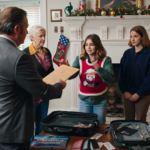
Two days before New Year’s Eve, I woke up early and drove to the farmers market. I picked the freshest produce I could find, filling a large woven basket before heading home. Then I started cooking my daughter Samantha’s favorite dishes—roasted chicken with herbs and lemon, and creamy mashed potatoes. The whole house filled with the warm aroma of roasted garlic and thyme.
My heart fluttered with excitement. I spread the tablecloth, fluffed the sofa pillows, and sat waiting, my eyes fixed on the door like a child waiting for Santa Claus. Samantha had just finished her first full-time job after graduating from college. She insisted on working until the very last day of the year to make a good impression on her boss.
Around 7:00 p.m., the front door opened. I jumped to my feet, smiling wide, my arms already open for a hug.
But Samantha didn’t even look at me. She went straight into her father’s arms—Zach’s arms—practically leaping into them.
“Dad, I got a $3,000 bonus this year.”
Zach’s face lit up like a Christmas tree, his eyes glowing with pride. He patted her head gently.
“That’s my girl. I’m so proud of you.”
Right then, my in-laws, Harold and Beverly, rushed in, their faces glowing with delight.
“Samantha, you’re the pride of this family,” Beverly said admiringly.
I stood off to the side, watching them all gather around her. Of course, I was happy for her, but still—there was a quiet ache inside me, the feeling of being forgotten. After all, I was the one who had raised her.
I stepped forward, smiling, and took her hand.
“You’ve had a long day. Are you hungry? I made your favorite dishes. I can heat them up for you.”
She didn’t even glance at me.
“Mom, can you stop asking stupid questions?” she snapped, visibly annoyed.
Then she bent down, unzipped her suitcase, and pulled out a stack of neatly wrapped envelopes, placing them proudly on the coffee table like she was about to announce the winners of a contest.
At that moment, Zach’s younger brother, Hansen, and his wife, Emily, walked in. Their eyes immediately landed on the envelopes.
“Wow, Samantha, looks like you’re doing great,” Hansen said, genuinely impressed. “I’m guessing those are gifts for everyone. That’s really thoughtful.”
As soon as Samantha saw Emily, she jumped up and hugged her tightly.
“Aunt Emily, I missed you so much.”
I froze. In that instant, I understood everything. My daughter could treat anyone like family—anyone except me.
As everyone gathered around her, Samantha cleared her throat and smiled brightly.
“To thank you all for your support this year, I got a little something for each of you.”
She handed her father a Visa gift card worth $1,000. Each of her grandparents received a $300 spa voucher. Her uncle and aunt each got a $200 gourmet grocery card. I didn’t move. I just watched her hand out the gifts one by one, smiling with pride.
Emily nudged her gently and whispered, “Sweetheart, I think you forgot someone.”
Samantha tapped her forehead playfully, pretending to remember.
“Oh my gosh, you’re right. I think there’s one more in my bag.”
Relief washed over me. So she hadn’t forgotten me after all. Maybe she had saved mine for last. Maybe it was something special.
I reached out my hand just as Samantha bent down, picked up our little dog, Coco, and nestled her in her arms. Then she tucked the last envelope into Coco’s sweater and said sweetly:
“This one’s for you, Coco, for being such a good girl this year.”
I stood there frozen, my smile stiffening, my hand hanging in the air—useless.
After a long pause, I managed to ask softly, “What about mine, Samantha?”
She turned toward me, her voice gentle but sharp.
“Mom, you’re home all day. You don’t work. You have no idea how stressful my job is. Sure, you cook and clean, but that’s your choice. You didn’t help me with anything important. Why would I give you a gift?”
Emily rushed over, pulling Samantha back toward the sofa, whispering for her to stop. But Samantha wasn’t finished. She smiled and pulled out another surprise from her purse.
“Oh, and guess what? I booked flights for everyone to spend New Year’s in Hawaii. We leave on New Year’s Eve at noon.”
I stayed quiet, thinking, “That’s fine. No gift for me, but at least we’re going on a family trip. Maybe that was her way of showing she cared. She was my daughter, after all.”
I started looking through the envelopes with the others, searching for my boarding pass, but I couldn’t find one. I looked up at her, confused.
She lifted her chin, speaking as if giving an order.
“Mom, you’re not coming. I need you to stay and watch Coco. She’d be miserable here alone, and you’re perfect for the job.”
That was the moment something inside me broke. To my daughter, I wasn’t even worth the price of a plane ticket.
Anger surged in my chest. I swung my arm, and the plate of cookies I had baked shattered on the floor. The sound exploded through the room like a fire alarm.
“Cheryl, what on earth is wrong with you?” Beverly shrieked, her voice piercing.
Harold frowned with disapproval. “You just ruined the night. What kind of behavior is that?”
Beverly muttered, “Zach… marrying a woman like this was the worst luck of your life.”
Samantha frowned. “Oh my god, Mom. It’s just a trip to Hawaii. I’ll take you next year when I get another bonus. But now you’ve made everyone upset. Happy now?”
Hansen opened his mouth to speak, but Emily grabbed his hand and shook her head.
I let out a bitter laugh.
“So that’s what it takes to get your attention, huh? I have to break something just to remind you I exist.”
Zach’s face darkened. His patience had run out.
“Do you have any idea how ridiculous you’re being right now? This was supposed to be a happy family gathering. You didn’t have to ruin it. If you can’t handle it, then leave. No one’s stopping you.”
The irony stung deep. I wasn’t part of this family. I was the unpaid maid—the one who cooked, cleaned, took care of the dog, and got ignored.
I tore off my apron, threw it aside, stormed into the bedroom, grabbed whatever clothes I could find, and stuffed them into a bag along with my wallet and ID. Just as I turned to leave, Emily ran after me, grabbing my arm.
“Cheryl, don’t do this. It’s late. Where are you going?”
She turned back and shouted, “Samantha, talk to your mom. Don’t let her leave like this.”
Samantha didn’t even sit up. She reclined on the sofa, eyes half closed, lips curled in disdain.
“Let her go. She’ll just run back to Grandma’s like always. She loves making a scene and then coming back.”
I stood there stunned. Over twenty years of love and sacrifice reduced to this. If my mother could hear how they spoke to me tonight, it would break her heart.
I pulled my arm free from Emily’s grasp, walked straight out the door, and didn’t look back.
Once I reached the sidewalk, I took out my phone and called my mom.
“Mom,” I said firmly, though my voice felt hollow, “I’m not coming home for the holidays. I need some time to myself. Maybe I’ll take a little trip.”
She paused for a few seconds, then replied gently.
“That sounds like a good idea, honey. A change of scenery might help. Just be careful.”
“Okay.”
Then, after a moment, she added, “Remember I told you I was thinking about selling the old house? Well, it’s done. The sale went through, and I’ve got the money. I’ll send you some.”
She could sense something was wrong, but she didn’t ask. She never pressured me—just supported me quietly, completely.
I said softly, “Mom, I’m fine. I don’t need anything right now, but thank you. If I ever do, I’ll ask. Thank you for always being there for me.”
She nodded. I could almost hear it through the phone.
But ten minutes later, I got a notification. She had transferred $3,000 to my account. The note read: “For my dear daughter, go live your life.”
It wasn’t the full amount—Mom had already set aside a much larger trust from the house sale—but this was what she sent right away so I could leave safely.
I cried, because having a mother who truly loves you means having the courage to walk away from anything that no longer respects you.
That night, I checked into a small boutique hotel downtown. For the first time in a long, long while, I lay in a bed that was mine alone and slept peacefully.
Early the next morning, as I sat by the hotel window with a cup of coffee, my phone rang. It was Zach. I hesitated, then answered. His voice was low but filled with irritation.
“Cheryl, how long are you going to keep this up? Come home now. I stopped by your mom’s place. She said you never showed up. I don’t care where you are—just come back.”
I didn’t say a word. I just ended the call. Who did he think I was—a maid on standby waiting for orders?
Moments later, my phone buzzed again. A flood of messages from Samantha.
“Mom, aren’t you too old to be acting like this? Disappearing just for attention. How childish can you be?”
“We’re flying to Hawaii tomorrow. If you don’t come back, who’s going to watch Coco?”
“If something happens to her, I’ll never forgive you.”
I stared at her words, a bitter smile curling on my lips. This was my daughter—the one I had raised with my own hands—talking to me like this. Once I saw her as my treasure. Now she saw me only as a burden, a helper.
Tears welled up again, but I let them fall and swore it would be the last time.
I remembered her as a little girl—sweet and full of love. She used to wrap her arms around my neck and whisper:
“Mom, you’re the best mom in the world. When I grow up, I’ll buy you the prettiest dress.”
I could still feel her small body curled in my lap, soft and smiling.
But after grade school, she began to change. Her grades slipped, and Zach said she needed more attention at home. He pressured me to quit my job, and I did. I became a full-time mom, giving up everything else for her. But the older she grew, the colder she became.
I still remember the day she stormed into the house, furious.
“Stop coming to parent-teacher meetings, Mom. Everyone knows you’re just a stay-at-home mom. It’s embarrassing. You can’t even help me with math. You don’t make money, and you still argue with Dad. What’s the point of you?”
I kept telling myself, she’s just young. One day, she’ll understand.
I waited through high school, through college. I thought once she entered the real world, she’d finally see everything I’d done for her. But no—this was what I got in return. Twenty years of silent, invisible sacrifice. And now here I was, staring at a daughter I could barely recognize.
Two days later, on New Year’s Eve, Samantha sent me her final messages.
“Well done. You’ve officially ruined everyone’s plans.”
“We’re leaving at noon. Don’t bother coming back.”
“If you’re not home by then, don’t expect to be my mother anymore.”
Perfect—because I was about to stop being her mother, too.
I opened my email and sent Zach the finalized divorce papers I had quietly prepared for months. Just one line in the message:
“Please sign them soon. If you refuse, I’ll proceed in court.”
Then I turned off my phone, grabbed my suitcase, and walked straight out the door toward the airport.
And just like that, I boarded a plane to Iceland—a land of ice and silence—to enjoy the first real vacation of my life.
Later, I learned Zach panicked when he saw the divorce papers. He called me again and again, but all he reached was the same cold voicemail message: The number you have dialed is not available.
Meanwhile, Samantha seemed calm—even smug. She patted his shoulder confidently.
“Dad, don’t worry. This is just Mom’s way of trying to make us give in. Classic manipulation. She’s a housewife who hasn’t left the house in years. Do you really think she’s getting divorced? Just let her sit there for a while. It’ll teach her a lesson. She’ll see who’s in charge here.”
Beverly nodded from across the room. “She’s gotten too spoiled,” she muttered.
Harold added with a sarcastic chuckle, “Divorce. Please. What kind of life does she think she’ll have without my son?”
And with that, the whole family cheerfully hauled their luggage to the airport, ready to start their vacation as if nothing had happened.
That night, after they arrived, I saw Samantha post a picture from the resort restaurant—champagne glasses raised, bright smiles all around, the image of a perfect family getaway. I looked at the photo, then calmly turned off my phone.
Meanwhile, I was sitting around a crackling bonfire in the Icelandic snow with a group of new friends, all bundled up in thick coats, clinking beer bottles, laughing freely. Snowflakes drifted around us and above. The northern lights danced across the sky. No obligations, no roles to play—just freedom, the kind I hadn’t felt in twenty years.
I let out a quiet laugh and whispered to myself:
“Being young is nice, but being free… that’s better.”
I took a few pictures of the aurora and posted them on Instagram with a short caption: Feels like a dream. You only get one life. Live it for yourself.
Less than a minute later, I received a new voicemail notification. It was Samantha. Her voice was sharp, furious.
“How could you do this? Are you using Dad’s money to go on a solo vacation? I’ve worked all year and barely saved a dime, and you’re just out there spending freely. Do you even care about anyone but yourself? You’re so selfish.”
I didn’t listen to the rest. I deleted it.
But she was right about one thing. I was being selfish. And for once in my life, it felt good—to breathe, to live on my own terms. I only regretted not doing it sooner.
Then I posted another photo—my boarding pass for a flight to Norway. The caption read: Simply, next stop, brighter still.
That was the moment Samantha finally broke.
She started calling nonstop, leaving frantic messages demanding answers.
“Why did you run away?”
“Why are you wasting money?”
“Why are you acting like a child?”
I didn’t answer a single call. In the end, I blocked her number.
Later, I found out she changed her flight and cut her Hawaii trip short—from seven days to two.
The next evening, she burst into my mother’s house and broke down crying in the living room.
“Grandma, Mom’s so selfish. She ran off abroad while we were trying to celebrate as a family. She cut us off. She’s spending all of Dad’s hard-earned money, and now she’s even blocked me. You have to make her see reason.”
My mom sat in silence for a long moment, then looked up and said calmly:
“Let me ask you something. When your whole family flew to Hawaii, did any of you ask if your mother wanted to come?”
Samantha froze. Her mouth opened, but no words came out.
Zach jumped in quickly, trying to smooth things over.
“See, you’ve got it wrong. Cheryl said she didn’t want to go. She was just trying to save money.”
My mom let out a dry, sharp laugh.
“Funny. You just said she was spending too much, and now she’s saving. Which is it?”
Then she leaned forward, her eyes steady.
“Let me make something clear. You don’t get to bully my daughter. She has me—and with my support, she’ll never need anyone’s pity or your crumbs.”
Then she stood, pointed at the front door, and said in a steady voice:
“Out.”
Zach and Samantha left, their heads bowed, shuffling silently out of the house.
Sitting in the car, Zach suddenly frowned.
“Wait a second,” he said. “Didn’t your mom say she wanted to sell the old house? From the way she talked today, she probably already did. And if that’s true, then she must have given all that money to your mother.”
Samantha’s face went pale.
“What? Grandma sold her house? That place was worth a fortune. Don’t tell me Mom used that money to file for divorce and run away. No way. We have to get that money back.”
From that day on, Samantha changed completely. The arrogance and smugness were gone. She texted me every day asking how I was feeling, whether I was happy, how the weather was, and when I planned to come home. She thought that with a few sweet words, I’d soften up like before.
But not this time.
I didn’t reply for days.
One evening, she sent a voice message, her tone trembling through the sound of quiet sobs.
“Mom, I was wrong. I’m sorry. I didn’t mean it. I was just angry. I didn’t think you’d really leave. Please come home. I promise I’ll change.”
I listened to the whole message and smiled faintly. She still didn’t understand. I didn’t leave over a plane ticket. I left because I finally saw the truth: I meant nothing to them. And I would never go back to that place again.
I deleted the message and went on with my life.
A month later, I returned.
When I walked through the door, Zach looked like a drowning man who had just found a life preserver. He quickly called out:
“She’s back. Hurry, get here. If she signs the final settlement, we’ll lose access to the $800,000 tied to her trust.”
Samantha arrived almost immediately. As soon as she saw me, she ran up with open arms.
“Mom, you’re back. I missed you so much.”
I raised my hand, stopping her before she could hug me. Calmly, I pulled the divorce papers from my purse and placed them on the table. My voice was steady.
“Sign them. Keep the house, the car, and the daughter. I don’t need anything.”
Zach’s smile vanished. His face went pale.
“Cheryl, how can you do this? Do you have any idea how hard I’ve worked for this family? You’ve lived comfortably at home for twenty years, and now you want to throw it all away because you feel left out. Is that really worth ending a marriage?”
I met his eyes coldly.
“You think being a housewife is easy? You think Samantha turned out like this by accident? You’re the one who made me quit my job to stay home and raise her. You’re the one who taught her to look down on me, to call me useless because I didn’t bring home a paycheck. Your parents mocked me over and over, and you never once defended me. And now you dare call me a freeloader.”
Zach’s face twisted, his voice turning sharp.
“If your mother didn’t have her inheritance money, none of this would be happening. She’s the one funding your little rebellion.”
Samantha, who had been pretending to be remorseful, snapped instantly.
“Dad’s right. You got money, and now you think you’re better than us.”
I looked at her, my voice calm but cutting.
“Samantha, I just hoped you’d learn to think for yourself instead of repeating everything your father says. I gave you everything—not so you could look down on me.”
She fell silent.
I turned to both of them and said slowly, “If you don’t sign, I’ll take it to court. I’m ready.”
Then I turned, opened the door, and walked out without looking back. In that moment, I knew I was finally free, and I would never return.
The next morning, Zach and Samantha showed up at my mother’s house. Later, she told me they looked exactly the same as always, with the same pleading voices—only the setting had changed. Yesterday, they had played the victims in front of me. Today, they were begging my mother, trying to manipulate through her instead.
“Like father, like daughter,” my mother said calmly.
She didn’t let them in. Standing in the doorway, she placed her warm cup of coffee on the small table by the entrance and said evenly:
“Cheryl is just exhausted after being pushed too far for too long. She hasn’t done anything wrong.”
Samantha froze, then forced an awkward smile.
“Grandma, we’re just worried Mom might do something impulsive financially. I mean—”
Zach quickly added, “Yeah, exactly. We’re only trying to protect the family’s assets. She’s just a little too emotional right now.”
My mother was silent for a moment, then smiled a thin, knowing smile that made both of them stiffen. Her tone was soft but sharp as a knife.
“Ah. So that’s what this is about. You came here to ask about the money, didn’t you?”
They started fumbling for words, but she didn’t let them continue.
“I’ve already spoken with my lawyer. Cheryl is an adult, fully capable of managing her own affairs. If you came here hoping to squeeze something out of me, don’t waste your time.”
She paused for a beat, then said each word clearly, like the steady strike of a hammer.
“Stop treating her like a weak housewife. She knows how to protect herself now—legally and otherwise.”
The door didn’t slam shut. But when it clicked into place, the silence that followed was heavier than steel.
That afternoon, I spent hours in my mother’s study. On the desk were folders sent by my lawyer—trust fund documents, bank statements, financial reports. I stared at them for a long time, overwhelmed. The papers in front of me weren’t something someone else handed me to sign on a line marked sign here. They were mine. I was the one making the decisions.
My mother stood by the bookshelf holding a teacup, her voice calm and steady. This money was originally meant for your future, to make sure you’d always have something to rely on, but it seems you need it now. She walked over, sat beside me, and placed her warm, fragile hand on mine.
“Your father and I realized too late that we should have protected ourselves sooner. By the time we learned that, it was almost too late. But you, my dear—you still have time.”
A lump rose in my throat, but my eyes stayed dry. The pain was too deep for tears.
I picked up the pen. I wasn’t signing an insurance policy for Zach, or a bank guarantee, or a joint property document. I signed my own name—for myself. I was the sole owner of that trust fund, and my hand didn’t tremble.
That day, I did a lot of important things. I froze all joint accounts with Zach. I opened a new account solely under my name. I updated my will and removed both Zach and Samantha from any financial access. I emailed Janet—my best friend from college and now my lawyer—with detailed instructions to proceed with the divorce. Janet had the mind of a legal encyclopedia and the loyalty of a sister. I called my financial adviser and activated enhanced verification. No transaction could be made without my direct approval and signature.
A week after finalizing the financial separation, Samantha reached out again. Her voicemail sounded light and sweet, as if nothing had happened.
“Mom, you’re amazing. Iceland and Norway just by yourself. I really admire that. Maybe next time we can go together.”
I didn’t reply.
The next day came another message, more tense.
“Mom, things aren’t great right now. My company’s downsizing. I might be out of work for a while. Can I stay with you for a bit?”
I still said nothing.
I wanted to see how far she’d take it.
Two days later, she sent a picture of her maxed-out credit card statement along with the message.
“My card hit the limit. I wish I hadn’t spent so much. I miss you, Mom.”
I almost laughed. Do you miss me, or my money?
I knew this playbook by heart: the tears, the apologies, the guilt trips, then the requests. If I gave in even once, the cycle would begin again.
I ignored her, but I saved every message and voicemail, took screenshots, and backed everything up, because I knew the remorse phase would turn into manipulation.
Sure enough, on the fifth day, she called. The moment I picked up, her voice trembled.
“Mom, I can’t take it anymore. I fell down the stairs in front of my building today. Nobody helped me. I was lying there and all I wanted was to call you.”
I said nothing.
After a few seconds, her tone shifted, sharper now.
“Mom, did you change the bank password? I tried to log in to check the electric bill and it says access denied.”
I smiled faintly and replied evenly. “I upgraded the account security per the bank’s recommendation. Identity theft is pretty common these days.”
Her voice shot up.
“Mom, I’m your daughter. Are you saying you’re protecting your account from me?”
I stayed calm.
“If you really want to help, send me the documents I asked for last month and never touch my accounts again.”
Silence hung for a few seconds. Then she let out a bitter laugh.
“So now I’m an outsider.”
I answered quietly. “You made yourself one the day you started treating me like an ATM.”
There was a loud clack—she’d slammed the phone down—followed by her scream echoing through the line.
“You think you’re so righteous? That trust fund isn’t just yours. You lived off Dad’s money your whole life, and now after the divorce, you’re keeping it all!”
Exactly. She didn’t want me. She wanted control—money, inheritance.
I tapped the screen and turned on the recorder. My tone stayed cool and steady.
“Samantha, you do realize this call is being recorded, right? I’ll be sending it to my attorney to request a no-contact order.”
The line went silent. Then I heard muffled sobs turning into full-blown crying.
“Mom, you’re cruel. Did you forget? When I had that fever, you stayed by my bed all night. You didn’t sleep. Doesn’t that mean anything to you?”
I took a deep breath.
“I remember,” I said softly. “I remember not drinking a sip of water that night because I was afraid you’d wake up and not see me there. I remember you at five years old saying you’d buy me a house one day. I remember you at ten promising to take me to Hawaii.”
“But I also remember when you told me you were embarrassed—that I was just a stay-at-home mom. When you banned me from school meetings. When you called me useless because I didn’t make money.”
She screamed, “So you’re cutting me off over that?”
My voice turned icy.
“No. I left because you used my love as leverage. Because you treated affection like a bargaining chip. I can forgive immaturity, but I won’t be emotionally blackmailed ever again.”
I ended the call, blocked her number, deleted all contact channels, and set up filters to prevent her from creating new accounts to reach me. I didn’t leave a single goodbye.
That night, I opened the fridge and saw the jar of pickles I’d made a few days ago, while still hoping she might come to apologize. I took it out and threw it straight into the trash. I wasn’t keeping anything anymore—not even hope.
The next morning, as I was pouring my coffee, Janet called.
“Cheryl, your husband made his move.”
She said, “Zach just filed a motion claiming partial rights to your trust fund. He’s arguing that since the money your mother transferred arrived during your marriage, it’s marital property.”
I let out a dry laugh. Of course he did. How much lower can he go?
But the truth was clear. My mother had transferred the money after I left the house, after I had fully separated my finances from Zach. It wasn’t a wedding gift or a joint investment. It was her support when I needed it most. The transfer note even said, “For my dear daughter, go live your life.” Everything was dated, verified, and traceable. Zach was twisting the timeline, trying to reframe the funds as marital property just because the divorce wasn’t finalized on paper yet.
I glanced through the packet his lawyer sent. It was pathetic. In the claim, Zach wrote, “The funds transferred by the mother-in-law during the marriage should be considered jointly owned marital assets.” And at the end, he added, “I have no objection to using these funds to support the family and secure our daughter’s future.”
Janet and I got to work immediately. We submitted every document—the transfer date two weeks after I moved out, the new bank account solely under my name, Zach’s total lack of access. Most importantly, we attached the original message from my mother that still sat in my phone.
“Don’t give him a single cent. For the first time in your life, spend money for yourself.”
This wasn’t a financial fight anymore. Zach wasn’t afraid of losing the marriage. He was afraid of losing control.
On the day of the hearing, he walked in wearing the same gray suit he’d worn at our wedding, trying to salvage what little remained. He stood up and said smoothly:
“I just want transparency regarding shared assets. We both have responsibilities toward our daughter.”
Janet opened her folder, her voice calm but cutting.
“First,” she said, “this sum was a personal gift from Cheryl’s mother for Cheryl’s use alone. Second, the transfer occurred after legal separation and Mr. Zach had neither access to nor management of the account. Third, Mr. Zach has a documented history of financial misconduct—loans, unauthorized transfers, and actions that severely undermined trust within the marriage.”
She slid the documents across the table. Inside were screenshots of bank records, the transfer note from my mother, the preserved message thread, and most damning of all, the loan contract Zach had once forced me to sign.
Thinking I hadn’t read the fine print, I heard his breathing hitch across the table. He hadn’t expected me to keep the receipts. He hadn’t expected the papers he once shoved in my face would one day become the very evidence used against him in court.
The judge—a woman in her early forties with a piercing, cold gaze—skimmed through the file, then looked up and said simply:
“It’s clear this money was a personal gift transferred after the parties had separated. Mr. Zach has no legal right to these funds.”
That short statement, though calm, carried the weight of a gavel strike.
“Zach, don’t touch my money.”
When we stepped out of the courthouse, Janet handed me a cup of coffee. We stood on the stone steps, watching Zach argue furiously with his lawyer. Janet smiled.
“Do you know what he’s really afraid of?”
I took a sip and said, “Enlighten me.”
She grinned. “He’s not afraid of losing the money. He’s afraid of you—afraid that you can finally spend money without needing his permission.”
I chuckled softly. “Divorce doesn’t scare him. What terrifies him is the idea that I left and I’m doing better than he ever will.”
I glanced down at the document in my hand. At the top of the page, it read: “Divorce officially filed.”
Those five printed words brought me more peace than any promise ever had.
That day, I didn’t go back to the old house. Instead, I stopped by the city library and filled out a volunteer application form. I’d always dreamed of working somewhere like that—helping people find books, guiding them through research, solving small problems that might brighten their day.
Years ago, when I mentioned this dream to Zach, he laughed.
“And how much would that job even pay? Just stay home and take care of the kid.”
So I shelved that dream.
But now, I was living for myself. And I thought: it’s time to try the life I once imagined.
Three days later, I sat at the volunteer desk by the library window and greeted my first visitor—an elderly woman who needed help printing her social security forms. I guided her through every step, showed her how to access the government website, how to recognize scam phone numbers, and even printed her medication interaction list. Before she left, she squeezed my hand.
“You’re more patient than my own daughter.”
I smiled, but said nothing. I’d heard that line before, but back then no one believed it. Now I heard it with pride, because it was the reward I had earned on my own.
On my way home, I sat on a bench near the little park on Main Street. An older woman with a walker stopped beside me, her eyes glancing at the lunchbox in my hands.
“Eating alone?” she asked.
I nodded.
She did too. “I got divorced at sixty,” she said. “I’ve been living and eating alone for twenty years, and each meal tastes better than the last.”
I laughed. “You’re not afraid of loneliness?”
Her smile was firm. “Of course I’m afraid. But that fear is nothing compared to living with someone who sees you as their maid.”
We didn’t know each other’s names, yet we sat quietly together in the afternoon sunlight—two women melted down and reforged by the fire of life itself.
That evening, I received an email from Zach. It contained one sentence: “Samantha’s falling apart. She says this divorce is destroying her.”
I didn’t open the attachment. I didn’t reply. I knew exactly what he was doing—trying to guilt me into coming back to play the obedient puppet again.
But I had finally learned one truth. Not every child deserves forgiveness.
When Zach disappeared from social media, I knew he had accepted defeat. What I didn’t know was that more defeats were waiting for him.
When his polished image cracked, the smiles at church vanished, too. The people who used to greet him turned their backs. That fragile social warmth evaporated like smoke. Then his health began to fail. The back pain he’d ignored for years grew worse. No one reminded him to eat. No one fetched his medication. Eventually, his company quietly removed his name from the employee directory. Official reason: concerns about personal credit.
I understood immediately. For years, he had used my name as a guarantor, mixing personal and business accounts, pretending to be the pillar of a stable household. Without me, even the court wouldn’t trust him—let alone the board of directors.
He turned to Samantha next, but she had her own troubles. After losing her job, Samantha started a women’s empowerment coaching business, teaching others how to be confident and independent. The irony: she had never learned either of those things herself.
Her ex-boyfriend got engaged just a week after their breakup, and Samantha collapsed. She posted a tearful video online telling the heartbreaking story of a mother who abandoned her daughter, but no one believed her. The comments split into two camps. One group wrote, “Your mom didn’t abandon you. She just chose herself.” The other reposted my picture under Iceland’s northern lights—my coat billowing in the wind—with the caption, “This woman isn’t running away. She’s coming home to herself.”
One person had liked that post: me.
I didn’t answer Samantha’s messages. I didn’t open Zach’s emails. They no longer deserved even a minute of my time. The only tie left between us was the legal bill.
I turned the whole story into a podcast episode about women rebuilding their lives after retirement. When it aired, the host closed with this message: This story comes from Cheryl Mitchell, a woman who wants to remind you that women aren’t born to fade quietly in the background. They’re born to shine.
The episode received far more responses than I expected. Hundreds of comments poured in.
“I cried listening to this. She made me believe I can start over.”
“She didn’t disappear. She woke up.”
That spring, I walked the forest trail on the west side of the city—sneakers on, water bottle in hand—chatting with my volunteer group. A woman gently took my hand and asked:
“Are you Cheryl? I listened to your story. You did what all of us are afraid to do.”
I smiled and squeezed her hand back, saying nothing, because I knew I was no longer the woman who cried by the stove, begging for freedom. I was the woman who walked away—head held high—smiling, and strong enough to help others walk beside her.
And my mother, Bess, later told me what happened the day Samantha and Zach showed up at her house. They came with fake smiles and a boxed gift, pretending they were just checking on her. But within minutes, they were circling the same question—about the money from the old house and whether I was managing it wisely.
My mother didn’t raise her voice. She simply let them talk until they revealed what they wanted, then shut the door on the conversation—and on them. She made one thing clear: no one would use her as a back door to reach me, and no one would touch a single cent that belonged to my future.
Hearing that was enough. I didn’t need every detail. I only needed to know this: for once, someone had stood between me and their greed, and I was not alone anymore.
Perhaps the most painful thing in life isn’t being betrayed, but realizing you’ve stayed silent for too long while being hurt. I once believed that love and family only required endurance and sacrifice. But the truth is, real love cannot exist when only one person carries all the weight.
Learning to let go isn’t always about losing someone. It’s about finding yourself again—a stronger, wiser version who knows how to stand guard over her own heart.
Now I no longer live in rooms filled with silence and tears. I live in the peace that comes from choice: the choice to love myself, the choice to start over, and the choice to believe that happiness still belongs to those brave enough to rise again.
News
My Daughter Planned An Elegant Dinner For Her Promotion. She Told Me, “Do Not Come Down, Mom. You Embarrass Me. My MIL Will Take Your Place.” I Smiled. When Everyone Sat Down, I Came Downstairs. AND WHAT I DID…
“Do not come down, Mom. You embarrass me. My mother-in-law will take your place tonight.” That was the sentence that…

My Son-In-Law Kicked My Daughter & Newborn Into A Blizzard For His Mistress
On the night the snowstorm swallowed Aspen, my daughter was shoved out of a mansion like trash, still bleeding from…

My Husband Took Me To Dinner With An Italian Client. I Sat In Silence, Pretending I Didn’t Understand Italian. But Then I Heard Him Say Something That Made My Blood Run Cold. I COULDN’T BELIEVE WHAT I WAS HEARING.
That night, my husband took me to a fancy Italian restaurant to meet an important Italian client. I sat beside…
On My Daughter’s Birthday, She Said, “The Greatest Gift Would Be If You Just Died.” So I Canceled Her House Funding, Withdrawing Everything, And Disappeared. The Next Day, SHE SAW WHAT I’D LEFT ON HER TABLE AND COLLAPSED.
On my daughter’s birthday, I stood in her perfect living room holding a chocolate cake, thinking I was bringing love….

I Was Sitting Quietly With My 7-Year-Old Grandson At My Son’s Second Wedding, When He Suddenly Gripped My Hand And Whispered “Grandma, I Want To Leave Now.” I Asked What Was Wrong And He Replied, Trembling, HAVEN’T YOU LOOKED UNDER THE TABLE?
My son’s wedding was in full swing, a joyful occasion—when my seven-year-old grandson suddenly tugged on my hand. “Trembling, Grandma,…
At 72, I Lived Alone In A Quiet House. Every Night My Son Called To Ask If I Was Alone. One Night I Lied To My Son, Because Someone Was Working My Back Door Lock And That Lie Saved My Life When Police Sirens Scared The Intruder Away
My name is Evelyn Hart, and I am 72 years old. Most nights my little house is so quiet that…
End of content
No more pages to load